OCB active deformation
Completed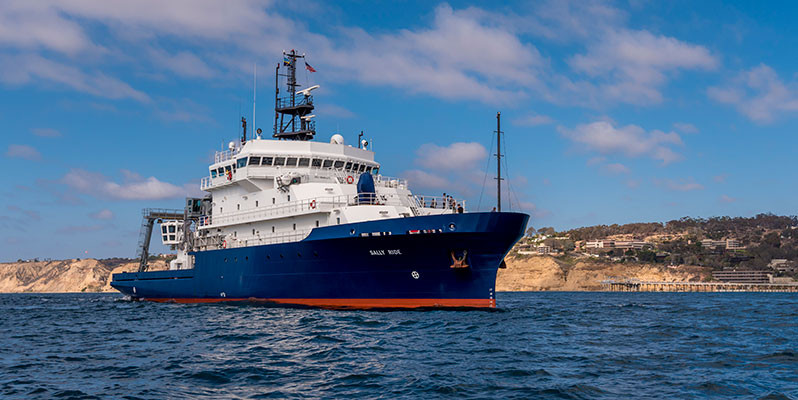
Planned route: 7 segments · ~29 hours steaming · 3 stations
Operating area: Cortes and Velero basins, Outer California Borderland
Route: San Diego (California) - United States → San Diego (California) - United States
Projects aboard (2)
OCB active deformation
The California Continental Borderland (CCB) currently forms the offshore part of the diffuse transform plate boundary between the Pacific and North American Plates in Southern California. Despite the hazard posed to densely populated coastal regions, these offshore fault systems are less constrained than their onshore counterparts. The most distal Outer California Borderland (OCB) remains understudied, and available slip rate estimates are mostly speculative, based on the unaccounted slip fraction from the total plate motion. Even though OCB crustal deformation may considerably increase the coastal earthquake hazard potential, OCB fault systems are currently not included in seismic hazard studies for the Southern California region or in the USGS Quaternary fault database. Additionally, slip across long and continuous ruptures in the OCB could generate local tsunamis caused by submarine landslides, especially if the faults are capable of experiencing multisegment ruptures. We want to collect novel high-resolution acoustic data in the OCB to constrain the fault geometry and determine the recency of activity for OCB faults. These data are necessary to increase the resolution of the Uniform California Earthquake Rupture Forecast (UCERF) -3 model and improve seismic hazard assessments for the city of San Diego and Southern California. We would like to operate the R/V Sally Ride and its hull-mounted acoustic array, including the EM712 and EM124 multibeam bathymetry system, and the new sub-bottom profiler, SBP29. The data will be used to identify new fault systems and collect evidence of active faulting and deformation in Cortes Basin and Velero Basin, located in the OCB approximately 150 km west off San Diego Bay. The proposed cruise based on the use of high-resolution geophysical techniques will aim to: Test the new Kongsberg SBP29 sub-bottom profiler in combination with Kongsberg EM712 and EM124 multibeam bathymetry systems, from medium to deep water environments (e.g., 1.5 to 3.8 km of depth); Resolve active fault systems and seafloor deformation in depositional Outer California Borderland basins, where the stratigraphy records tectonic history; Estimate lateral and vertical fault displacement; Assess the presence of landslides and submarine canyons, useful to define fault-related seafloor deformation and recency of faulting; Understand the kinematic role of the Outer California Borderland in the tectonic evolution of the California Continental Borderland and estimate the seismogenic and tsunamigenic potential;
People aboard
OCB active deformation
- Andrea Fabbrizzi · Principal investigator
CCBStructures-2023
- Brian Oller · Principal investigator
Party size: 20
Estimated vacant berths: 6
Equipment
Aboard the vessel
- Echosounder, 12kHz
- Echosounder, 3.5kHz CHIRP
- Multibeam - Deep Water (EM122, EM124)
- Multibeam - Shallow-water (EM710/712/2040/Seabat 7100)
- Echosounder, 3.5kHz CHIRP
- Multibeam - Deep Water (EM122, EM124)
- Ship Fitted Winches & Wires
- Crane
- Stern A-Frame
Pooled / portable
- CTD
- XBT
- Dredge
Schedule data from UNOLS Marine Facilities Planning · operator cruise code SR2303 Oller · MFP references 22/2509, 22/2639 · synced Sep 30, 2026