N Atlantic Porewater Nd
Completed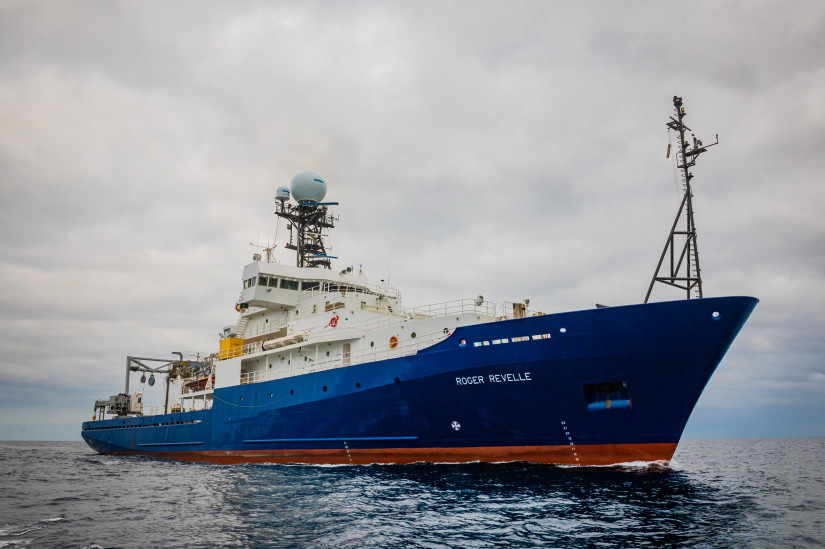
Planned route: 25 segments · ~12 days steaming · 20 stations
Operating area: Labrador Sea
Route: Woods Hole (Massachusetts) - United States → Reykjavik - Iceland
Scripps Institution of Oceanography
Projects aboard (2)
N Atlantic Porewater Nd
This project will investigate neodymium sources in the Northwest Atlantic, with a particular focus on benthic fluxes from sediments. Neodymium (Nd) isotopes are a key paleoceanographic tracer with the potential to provide information about connections between ocean circulation and climate over a range of timescales, however uncertainty in our understanding of Nd sources to the ocean limit their utility. In particular, recent studies have brought to light the importance of benthic Nd sources as a possible primary control on Nd distributions in the ocean. If this is true, it complicates the interpretation of Nd isotope distributions, which were traditionally thought to reflect largely conservative mixing between endmembers in the North Atlantic and North Pacific. A newly developed model of Nd in the modern ocean predicts that benthic fluxes are large in the Northwest Atlantic, a key region for the formation of North Atlantic Deep Water (NADW). There are only ten locations where benthic Nd fluxes have been directly measured, with no previous studies in the high-latitude North Atlantic. We will directly address this data deficit and test the model predictions by measuring benthic Nd fluxes along two depth transects in the Labrador Sea. We will measure Nd concentrations and isotopic compositions in pore water, seawater, and near seafloor particles in order to calculate Nd fluxes to the ocean from sediments and determine how those fluxes impact seawater Nd isotope values. We will measure other pore water and sedimentary components in order to characterize the diagenetic environment in the sediments and untangle the mechanisms driving Nd uptake/release. This will provide a thorough and holistic picture of Nd cycling in the Labrador Sea, including determining how the isotopic composition of NADW is set (both today and in the past) and what signals (bottom water versus pore water) are being recorded in authigenic records.
People aboard
N Atlantic Porewater Nd
- Sophia Hines · Principal investigator
Labrador Sea Benthic Fe
- Sophia Hines · Chief scientist
- Lisa Herbert · Principal investigator
Party size: 22
Estimated vacant berths: 15
Equipment
Aboard the vessel
- Meteorological Data
- Echosounder, 12kHz
- Echosounder, 3.5kHz CHIRP
- Pinger, 12kHz
- Multibeam - Mid-Water (EM302/304)
- Overboarding Cable - Fiber Optic
- Dynamic Positioning (DP)
- Underway Seawater System
- pCO2
- Dynamic Positioning (DP)
- Meteorological Data
- Echosounder, 12kHz
- Echosounder, 3.5kHz CHIRP
- Ship Fitted Winches & Wires
- Crane
- Stern A-Frame
- Navigation - Heading/Position
- ADCP/UHDAS – range < 80m (eg. 300kHz)
- ADCP/UHDAS – range 250-350m (e.g. 150kHz)
- ADCP/UHDAS – range 1000m-1200m (e.g. 38kHz)
- ADCP/UHDAS – range 500-750m (e.g. 75kHz)
- Multibeam - Shallow-water (EM710/712/2040/Seabat 7100)
Pooled / portable
- CTD
- XBT
- Sediment Core
- Winch Pool Portable Winch
- WHOI MISO Camera System
- CTD
- Sediment Core
- Winch Pool Portable Winch
- WHOI MISO Camera System
- Portable Laboratory Van(s) - NSF Van Pool
Schedule data from UNOLS Marine Facilities Planning · operator cruise code RR2504 Hines · MFP references 21/1302, 24/4274 · synced Sep 30, 2026