ASTRAL
Completed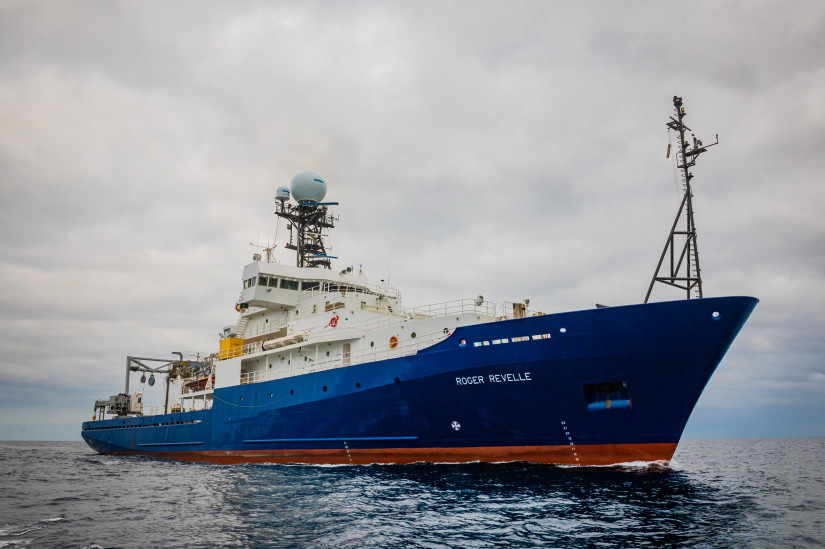
Planned route: 3 segments · ~6 days steaming · 1 station
Operating area: Northern Arabian Sea
Route: Mormugao (Marmagao/Marmugao) (Goa) - India → Mormugao (Marmagao/Marmugao) (Goa) - India
Scripps Institution of Oceanography
Project aboard
The Arabian Sea is a critical moisture source for the southwest monsoon, which influences the health and livelihoods of the billions of people inhabiting South Asia. The southeastern Arabian Sea develops a ‘mini warm pool’ region with SSTs rising through the low wind, clear sky conditions of the boreal spring intermonsoon period, reaching peak values prior to the onset of the summer monsoon. When present the mini warm pool sets up a north-south SST gradient with cool waters to the north and warmer waters to the south. Limited observations of the atmospheric boundary layer (ABL) show similarly strong latitudinal variation in structure (mixed layer height, stability, and inversion strength) and turbulent surface fluxes. With the onset of the summer monsoon the mini warm pool collapses suddenly (over a few days to week) and the latitudinal SST gradient is eroded. The coincident evolution of the ABL and air-sea exchange has yet to be observed. In the upper ocean, the seasonally reversing exchange with the neighboring, fresh Bay of Bengal controls the stratification of the mini warm pool region. The role of ocean dynamics in the maintenance and collapse of the mini warm pool is still an open question although previous studies have pointed toward the importance of salinity-stratified barrier layers—a remnant signature of lateral stirring between the Arabian Sea and Bay of Bengal waters. Land-locked to the north by south Asia, the Arabian Sea is a natural laboratory for the study of localized air-sea interaction with limited influence by remote atmospheric waves but a clear north-south variation in ocean stratification (temperature and salinity) that evolves rapidly in time (scale appropriate for ship-based study). The proposed research effort will combine new atmosphere-ocean observations acquired via autonomous and ship-based platforms with multi-tiered modeling (process-resolving idealized modeling, coupled regional modeling, and data assimilative forecasting) to understand the dynamical mechanisms that control the structure and coupling across the ocean and atmospheric boundary layer, i.e., “the transition layer”, in the Arabian Sea, and, consequently, to provide a framework for resolving coupled model biases in the region’s ocean heat, atmospheric moisture, and precipitation. Fieldwork and modeling will be designed to address the following questions: What processes control the maintenance and dissipation the Arabian Sea warm pool? How does variation in warm pool strength and stability in the ABL modulate local air-sea fluxes? How does the collapse of the warm pool change boundary layer structure and surface fluxes? What exchange processes are misrepresented in coupled models leading to moisture & precipitation dry biases in forecasts? Do improved physical parameterizations of local air-sea exchange lead to improved ocean and atmosphere forecasts from short-term to sub-seasonal to climate time scales?
People aboard
- Craig Lee · Principal investigator
Party size: 30
Estimated vacant berths: 7
Equipment
Aboard the vessel
- Meteorological Data
- Echosounder, 12kHz
- ADCP/UHDAS – range < 30m (e.g. 600kHz-1200kHz)
- ADCP/UHDAS – range < 80m (eg. 300kHz)
- ADCP/UHDAS – range 250-350m (e.g. 150kHz)
- ADCP/UHDAS – range 1000m-1200m (e.g. 38kHz)
- ADCP/UHDAS – range 500-750m (e.g. 75kHz)
- HDSS (140kHz + 50kHz)
- Multibeam - Deep Water (EM122, EM124)
- Multibeam - Mid-Water (EM302/304)
- Science (Wave/Ice) Radar
Pooled / portable
- CTD
- Gyrocompass
- Other AUV
Science party brings
- Portable Laboratory Vans/Containers - Science Supplied
- Science Supplied Portable Winch
- Science-provided vans ×2
Schedule data from UNOLS Marine Facilities Planning · operator cruise code RR2306 Lee · MFP reference 21/949 · synced Sep 24, 2026