QUICCHE - 2023
Completed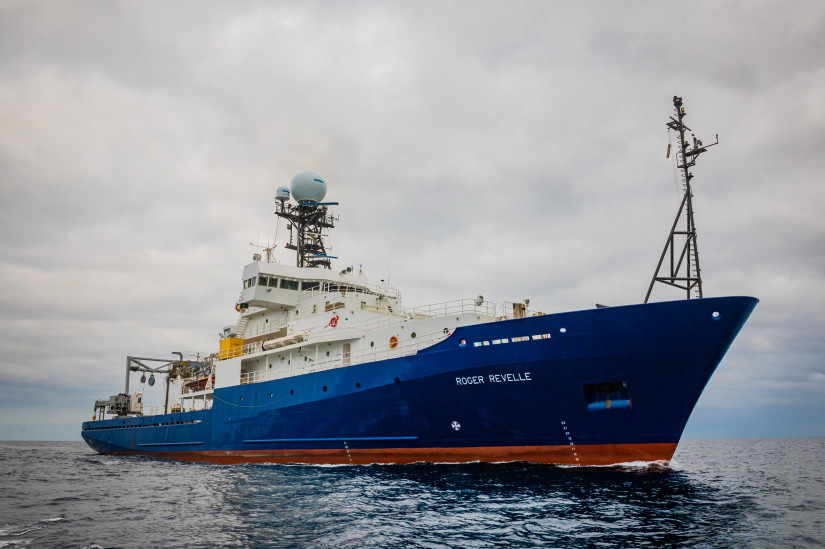
Operating area: Cape Basin, Southeast Atlantic
Route: Cape Town (Western Cape) - South Africa → Cape Town (Western Cape) - South Africa
Project aboard
Model studies and satellite data suggest that Agulhas leakage -- the flux of Indian Ocean waters into the South Atlantic -- is increasing with climate change and that the associated trend in salt flux into the Atlantic may help stabilize the Atlantic meridional overturning circulation. Agulhas leakage also impacts the adjacent Benguela upwelling system, with increasing eddy kinetic energy expected to flush more nutrients and organisms offshore, causing a reduction in the productivity of this important fishery. So far, the turbulent nature of leakage has confounded observational evidence for these trends and influences. Here we propose an entirely novel approach to this important problem, using an eddy flux framework. Along the way we will be the first to characterize stirring and mixing in the unique eddy-dominated flow regime of the Cape Basin. The objectives of our project are to: (1) Observe and characterize submesoscale features generated by the mesoscale eddy strain field within the Cape Cauldron for the first time. (2) Make novel estimates of Agulhas leakage fluxes with these new observations, using theoretical eddy diffusivity and eddy flux frameworks. (3) Relate diffusivity and fluxes to new and existing satellite altimeter observations to infer variability in Agulhas leakage. To achieve these objectives we will collect new observations within the Cape Basin, targeting several dynamical regimes -- e.g. filamentation, eddy-eddy interaction -- to measure the related submesoscale features and estimate diffusivities. From these measurements we will quantify eddy heat and salt fluxes, similar to the way poleward heat flux has been successfully estimated in the Southern Ocean. We will use both Eulerian and Lagrangian instrumentation, including moorings, an undulating CTD system, gliders, drifters, profiling floats, and microstructure turbulence profilers, capturing time and space scales from hours to seasons and from 1 to 100 km. Our new observations will be synthesized and analyzed alongside other datasets, including measurements from the SWOT crossover in the Cape Basin and output from a 1/60 degree simulation, in order to generate a proxy for decadal leakage variability that can constrain climate projections.
People aboard
- Lisa Beal · Principal investigator
Party size: 19
Estimated vacant berths: 18
Equipment
Aboard the vessel
- Dynamic Positioning (DP)
- Underway Seawater System
- Meteorological Data
- Echosounder, 12kHz
- ADCP/UHDAS – range < 80m (eg. 300kHz)
- ADCP/UHDAS – range 250-350m (e.g. 150kHz)
- ADCP/UHDAS – range 1000m-1200m (e.g. 38kHz)
- Multibeam - Deep Water (EM122, EM124)
- Biological multi-frequency echosounder - EK80
Pooled / portable
- CTD
- Winch Pool Portable Winch
Science party brings
- Science Supplied Portable Winch
Schedule data from UNOLS Marine Facilities Planning · operator cruise code RR2302 Beal · MFP reference 21/802 · synced Sep 24, 2026