SUP05 Nitrogen Cycling
Completed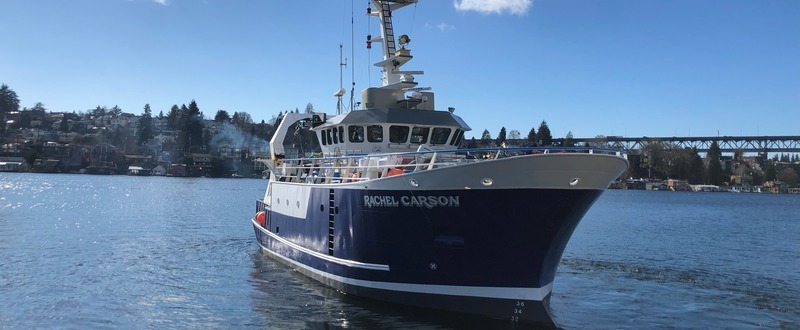
Planned route: 6 segments · ~44 hours steaming
Operating area: Near Vancouver Island
›2 legs· Seattle (UW Pier) (Washington) - United States → Seattle (UW Pier) (Washington) - United States
- 1Seattle (UW Pier) (Washington) - United States→Friday Harbor (Washington) - United StatesJul 15 – Jul 20, 2025 · 4 d
- 2Friday Harbor (Washington) - United States→Seattle (UW Pier) (Washington) - United StatesJul 21 – Jul 27, 2025 · 6 d
Project aboard
Bacteria and their viruses (phages) comprise a massive reservoir of genetic information that is exchanged and rearranged though a broad range of host-virus interactions. For example, marine phages can kill their host, modify their host’s genome, or use virally encoded auxiliary metabolic genes (AMGs) to regulate host metabolic processes during an infection. This suggests that phages can contribute directly to the cycling of key nutrients such as carbon and nitrogen. Nitrogen cycling is particularly important in Oxygen Minimum Zones (OMZs) where up to 25% of the fixed nitrogen in the ocean is lost as microbially produced gas through denitrification and other processes. The chemoautotrophic and denitrifying bacteria SUP05 is one of the most abundant clades in OMZs, with up to a third of these cells being reported as infected with phages. This suggests that cells infected with viruses (virocells) impact nitrogen cycling and particularly nitrogen loss through denitrification. Much of what is currently known about SUP05 and their phages is from ‘omics’ analyses, which largely result in highly fragmented and non-clonal genomes. These sequence data suggest that some SUP05 have the potential to carry out all the sequential steps in denitrification, producing N 2 gas. However, other cells appear to have incomplete denitrification pathways, leading to the production of key N-cycling intermediates such as nitrite (NO 2 - ) and nitrous oxide (N 2 O), a potent greenhouse gas. Yet, whether missing steps in denitrification are due to encoding of incomplete pathways or are an artifact of fragmented and incomplete genomes is not clear. Further, the conditions for N-cycling (link) versus N-loss (sink) processes by SUP05 are unknown. Evidence of interactions and cultured host-virus systems are needed to determine the denitrification activities of cells and virocells under different conditions. This project represents an interdisciplinary study that will use a combination of field observations, mesocosm experiments, and laboratory studies to identify the roles of genetically distinct cells and virocells in N-link and N-sink processes.
People aboard
- Robert Morris · Principal investigator
- Robert Morris · Chief scientist
Party size: 9
Estimated vacant berths: 4
Equipment
Aboard the vessel
- Ship Fitted Winches & Wires
- Stern A-Frame
Pooled / portable
- CTD
Schedule data from UNOLS Marine Facilities Planning · operator cruise code RC-0140 Nitrogen Cyc · MFP reference 23/3419 · synced Sep 24, 2026