VesselConnect

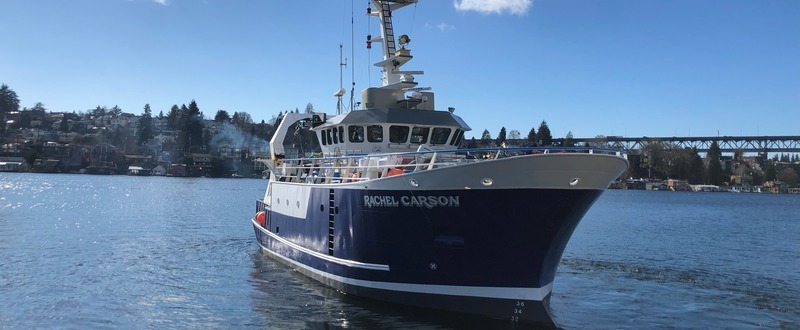
Rachel Carson

UNOLS · University of Washington's School of Oceanography

Rachel Carson photo 1USAphoto: courtesy University of Washington

Marine biology, university teaching

Loading map…

Apr 2026 – Oct 2026 · 39 port calls · 5 at-sea periods

Operating area: Carson is capable of conducting operations within the Salish Sea and coastal waters of the western United States and British Columbia

13

Research bunks

22 m

Length

9 kn

Cruise speed

14

Endurance

2003

Year built

5

Crew

Projects

12+ past

Completed

Joint WA Acoustics Moor Deploy '25

John Mickett · UW

This ONR-TFO project continues work to improve the understanding and prediction of mid-frequency sound propagation in coastal environments. This will be accomplished via a collaborative effort between UW-APL Ocean Acoustics ( DJ Tang, T. Hefner ), UW-APL Ocean Physics ( R. Harcourt, J. Mickett ), Scripps Institution of Oceanography ( Y-T Lin, W.S. Hodgkiss ), and NRL Stennis (G. Jacobs, J. Osborne). The primary goals of the fieldwork component of this project are to: Quantify the dependence of the large high-frequency variability (scintillation, when under sampled) in transmission loss due to stratification and internal wave spectra along the acoustic path. Collect highly-resolved towed profiler measurements to allow a statistical representation of high-frequency internal waves to facilitate prediction of TL variability at O (10) minute timescales, and to enable a priori assessment of acoustic signal uncertainty. Collect coordiated oceanographic and acoustic measurements to better quantify the impact of nonlinear internal waves---energetic, ubiquitous and regular on the Washington shelf---on mid-frequency acoustic propagation. Both along and across-wavecrest studies will be carried out. Collect microstructure measurements along with towed profiler measurements to improve our understanding of how acoustic ducts are modified by turbulent mixing. Are ocean model lateral and vertical diffusivity levels realistic? Support APL and Scripps Acoustics field experiments by providing comprehensive moored and towed profiler measurements to resolve the dominant variability of the sound speed environment, allow interpretation of changes to this field, and enable post-experiment acoustic modeling.

Sep 23 – Sep 28, 2025 · 4 d

Washington Shelf ~ 40 miles west of Grays Harbor

Completed

Ocean 492 Course - Fall 2025

Robert Kamphaus · UW

UW Oceanography Dept. Ocean 492 Research Apprentices Student Cruise for Fall Quarter 2025.

Oct 13 – Oct 15, 2025 · 2 d

San Juan Island and Strait of Juan de Fuca

Completed

Ocean 220 Course - 2026

Robert Kamphaus · UW

The student cruise for the Ocean 220 Course in Spring 2026

Apr 6 – Apr 10, 2026 · 4 d

Pacific NW

Completed

WOAC-2026-Spring

Jan Newton · UW

Oceans, estuaries and coastal habitats are changing quickly, driven by both natural processes and human activities. The Washington Ocean Acidification Center (WOAC) was established by the state legislature to advance research and monitoring of ocean acidification and its biological effects in Washington waters. One facet of that research is the WOAC cruises. We go out three times a year, April, July, and September, to monitor ocean acidification and its affect on biology. These cruises are part of a long term time Ocean Acidification time series.

Apr 13 – Apr 18, 2026 · 4 d

Puget Sound

Completed

Ocean 201 Course - 2026

Hilairy Hartnett · UW

UW Oceanography Dept. Ocean 201 Student Cruise for May 2026.

May 4 – May 8, 2026 · 3 d

Puget Sound

Completed

Salish GasEx

David Ho · UH

Marine carbon dioxide removal (mCDR) has the potential to contribute to climate change mitigation; however, the rate at which the mCDR industry must scale to enable meaningful removals presents substantial challenges. The next decade will be pivotal; it is now critical to establish pilot projects that demonstrate proof of concept and provide a basis for scaling. This project will conduct an ocean alkalinity enhancement (OAE) pilot project in partnership with an mCDR startup company in the Salish Sea. The investigators will utilize a numerical modeling framework to design this experiment, including a release strategy and a sampling plan that enable tracking of environmental impacts. The project will consist of a research cruise planned for the summer of 2026, consisting of a 3 He and SF₆ tracer release experiment to determine gas transfer velocities and mixing rates, important yet uncertain factors determining the spread of alkalinity and CO₂ uptake rates in coastal environments.

May 16 – May 25, 2026 · 9 d

Salish Sea

Completed

Puget Methane - Case Inlet

Harlan Paul Johnson · UW

Puget Sound has been observed to host large fields of active methane venting from the seafloor. Although present throughout the Sound, the majority of gas emission sites are co-located over three major fault zones that fracture the entire forearc crust of the Cascadia Subduction Zone (CSZ). Multibeam and single-beam sonar data from cruises conducted between 2011- 2021 identified the acoustic signature of over 350 individual bubble plumes. Fluid samples from adjacent terrestrial hot springs and deep-water wells surrounding the estuary contain a helium-3 isotope signature, suggesting a deep fluid source arising from the underlying CSZ plate interface. However, limited data from our previous pilot study suggests that Puget Sound emission sites appear to lack similar helium isotope signatures expected from a deep plate-interface reservoir. As an alternative hypothesis, a shallow reservoir beneath the Holocene sediments that cover Puget Sound Eocene basement, with horizontal transfer to the thinly-sedimented Alki Point and Kingston Arch anticlines, is also possible. The origin of vigorous marine methane plumes arising from areas of thin sediment cover and associated with deeply-penetrating forearc fault zones but still presenting no thermal or chemical anomalies found in other similar forearc environments, remains an important unresolved scientific paradox.

Jul 10 – Jul 11, 2026 · 2 d

Case Inlet

Completed

WOAC-2026-Summer

Anna Boyar · UW

Oceans, estuaries and coastal habitats are changing quickly, driven by both natural processes and human activities. The Washington Ocean Acidification Center (WOAC) was established by the state legislature to advance research and monitoring of ocean acidification and its biological effects in Washington waters. One facet of that research is the WOAC cruises. We go out three times a year, April, July, and September, to monitor ocean acidification and its affect on biology. These cruises are part of a long term time Ocean Acidification time series.

Jul 13 – Jul 18, 2026 · 4 d

Puget Sound

Completed

IRISS-USV

Andrew Jessup · UW-APL

The PI has developed an instrument called IRISS-OPT (InfraRed Instrument for Sea Surface temperature-Optimal Band) for measuring ocean surface skin temperature. IRISS-OPT combines a simplified one-point in situ calibration with the so-called optimal band technique. IRISS has demonstrated an accuracy comparable to the proven instrument known as ROSR (Remote Ocean Surface Radiometer). Modeled profiles of air temperature and water vapor are used to replace the sky radiance measurement. The combination of the simplified calibration and elimination of the sky measurement using IRISS-OPT now makes it practical for deployment on Uncrewed Surface Vehicles (USVs) and buoys. The proposal activity is to develop IRISS-USV, a version of IRISS-OPT for routine use on Uncrewed Surface Vehicle (USVs) and buoys. The primary activity will be to develop stand-alone versions with internal recording and optional external serial output. Two existing prototype units will be upgraded for use on a buoy. Two new units with a reduced form factor to fit on the saildrone USV will be designed and fabricated. The units will be validated at sea on a research vessel and buoys. A secondary activity will be to develop look-up tables for the atmospheric radiance needed to forego a separate sky measurement.

Jul 21 – Jul 28, 2026 · 7 d

Washington State Coast

Completed

Endeavour EXTEND

William Wilcock · UW

This is a collaborative project involving scientists from the University of Washington (Wiliam Wilcock, Marine Denolle), Dalhousie University (Miao Zhang, Mladen Nedimovic, Alexandre Plourde) and Ocean Networks Canada - University of Victoria (Martin Heesemann). The proposal seeks to operate autonomous broadband ocean bottom seismometers (OBSs) from the Canadian National Facility for Seismological Investigations (NSFI) at the Endeavour segment of Juan de Fuca Ridge to complement the Ocean Networks Canada cabled seismic network. The experiment is motivated by the observation that seismicity rates on the Endeavour have been increasing in recent years and it is likely that the segment will experience another ridge spreading event that similar to the sequence of diking events that ruptured the entire segment between 1999-2005. The OBSs will be used to obtained improved earthquake catalogs, search for temporal changes in crustal velocity so as to address questions regarding the stresses that trigger diking events, the impact of propagating rift tips on the Endeavour hydrothermal vent fields, the impact of carbon dioxide exsolution on off axis seismicity, and the temporal patterns of aseismic strain surrounding diking events.

Aug 3 – Aug 18, 2026 · 14 d

Endeavour Segment of the Juan de Fuca Ridge, Northeast Pacific Ocean

Completed

MATE Floats 2026

Sasha Seroy · UW

This is a student training cruise to expose technical community college students to oceanography and ocean instrumentation. The one-day cruise is part of a week-long workshop hosted at UW where community college students will learn about basic oceanography, sensors, instrumentation and data analysis. The goal of the cruise is to give these students hands on experience on a research vessel working with various tools and sampling protocols on board. Students will conduct a CTD cast, collect water samples to run chlorophyll and oxygen on board, collect plankton, and complete a sediment grab. After the cruise, students will work on data analysis as a part of the workshop.

Aug 20 – Aug 21, 2026 · 1 d

Seattle

Completed

WOAC-2026-Fall

Anna Boyar · UW

Oceans, estuaries and coastal habitats are changing quickly, driven by both natural processes and human activities. The Washington Ocean Acidification Center (WOAC) was established by the state legislature to advance research and monitoring of ocean acidification and its biological effects in Washington waters. One facet of that research is the WOAC cruises. We go out three times a year, April, July, and September, to monitor ocean acidification and its affect on biology. These cruises are part of a long term time Ocean Acidification time series.

Sep 14 – Sep 19, 2026 · 4 d

Puget Sound


Are you the operator of this vessel?