DON
Completed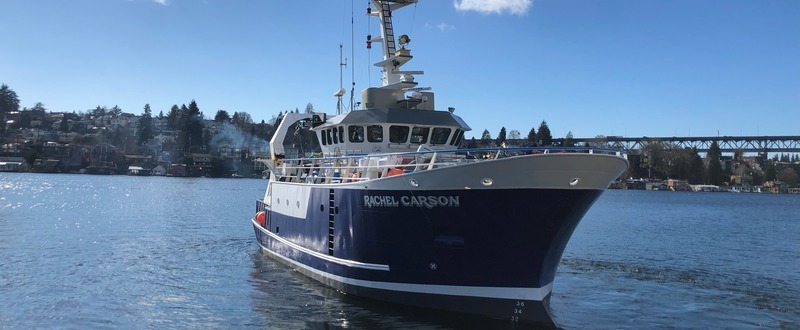
Planned route: 7 segments · ~19 hours steaming · 6 stations
Operating area: Salish Sea
Route: Seattle (UW Pier) (Washington) - United States → Seattle (UW Pier) (Washington) - United States
Project aboard
Marine phytoplankton produce and release nitrogenous metabolites that fuel and shape microbial communities. Yet, our understanding of the quantitative and qualitative significance of these metabolites is limited by our inability to measure them. We have developed a suite of cation exchange and hydrophilic interaction liquid chromatography and high resolution mass spectrometry methods that allow us to quantify hundreds of intracellular and extracellular metabolites in marine microbial communities and track isotope labeled metabolites through metabolic pathways. Using these methods, we will quantify particulate and dissolved nitrogenous metabolites and their production rates in phytoplankton cultures and the surface ocean. Preliminary analyses of particulate and dissolved organic matter from the North Pacific show that homarine, a substituted pyridine, is often the most abundant compound we measure. Homarine was first found in lobster almost a century ago, but has rarely been measured in the ocean and is not currently recognized as a currency in the microbial loop. We have found homarine in high abundance in select phytoplankton cultures including Synechococcus , diatoms, and haptophytes as well as evidence that only select bacteria can consume homarine. To better constrain the function of homarine, we will isolate homarine consuming heterotrophic bacteria and use mutagenesis techniques, transcriptomics, and incubations with isotopically-labeled homarine to annotate genes and characterize the biochemical reactions mediated by each protein involved in the degradation of homarine. To confirm gene annotations, look for additional pathways for the flow of homarine, evaluate the effect of homarine on growth, and determine the kinetics of homarine uptake, we will carry out incubations of stable isotope labeled homarine in phytoplankton cultures, heterotrophic bacterial cultures, and natural communities. Finally, we will identify homarine consumers and biochemical pathways for homarine use in the environment by mining existing environmental metatranscriptomes for homarine catabolism genes.
People aboard
- Oscar Sosa · Chief scientist
- Anitra Ingalls · Principal investigator
Party size: 8
Estimated vacant berths: 5
Equipment
Aboard the vessel
- Stern A-Frame
- Underway Seawater System
Pooled / portable
- CTD
- Grab Sampler
- Other ROV
Schedule data from UNOLS Marine Facilities Planning · operator cruise code RC-0138 DON · MFP reference 22/2543 · synced Sep 24, 2026