Common Era North Pacific Typhoons - Micronesia
Completed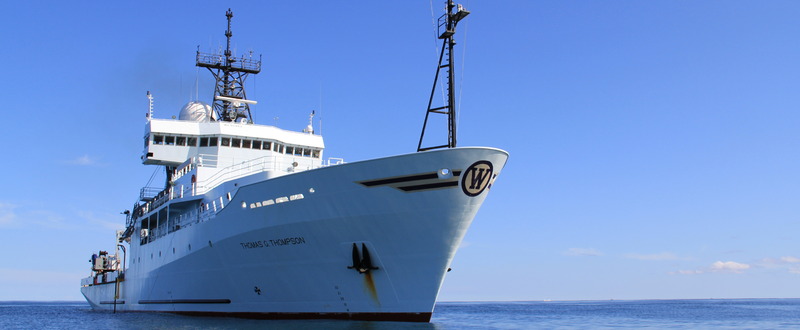
Operating area: Micronesia
Route: Apra (Agana) - Guam → Apra (Agana) - Guam
Project aboard
The western North Pacific is the most active tropical cyclone basin in the world, with an average of 40 storms per year. Efforts to understand the driving mechanisms responsible for modulating tropical cyclone activity are significantly hampered by a short instrumental record. The abbreviated observational record does not permit the identification and characterization of climate forcings that may influence storm activity on centennial and longer timescales, including climate conditions for which there are not analogous historic observations. Instrumental archives in the western North Pacific only extend back to the middle 20 th century and the often incomplete historic record extends back to European colonization of the region. Over the past decade, proxy reconstructions have been developed, elucidating millennial and centennial-scale patterns in tropical cyclone activity. Coarse-grained storm-induced deposits, preserved in coastal sedimentary basins, are particularly effective proxies for intense tropical cyclone impacts at a site. Previously published work and preliminary data show that deep coastal depressions with rapidly accumulating sediments contain high-resolution records of the passage of intense tropical cyclones. These extraordinary sedimentary basins provide a means of extending documentary records of tropical cyclone strikes back millennia, and allow for i) the examination of climate/tropical cyclone interactions that lack modern analogs, ii) the generation of more accurate reoccurrence rate estimates, and iii) assessment of variations in storm activity on sub-millennial time scales. We propose to build on our previous work by exploiting archives of intense tropical cyclone passage across a geographic array of sites in the western North Pacific aimed at examining how tropical cyclone activity there may have varied over the last two millennia. These reconstructions can then be used to begin to explore the climatic drivers of changes in tropical cyclone activity in the western North Pacific. For example, as some of our recent work shows, shifts in the position of the intertropical convergence zone and the evolution of El Niño Southern Oscillation variability over the last millennium may have played a significant role in driving dramatic changes in intense tropical cyclone activity at Jaluit Atoll in the Marshall Islands. The results of this study will provide essential data on past patterns of tropical cyclone activity in the western North Pacific, and offer broader insight into climate factors that modulate tropical cyclone frequency, intensity, track, and area of development.
People aboard
- Jeffrey Donnelly · Principal investigator
- Davin Wallace · Chief scientist
Party size: 20
Estimated vacant berths: 15
Equipment
Aboard the vessel
- Dynamic Positioning (DP)
- Echosounder, 12kHz
- Echosounder, 3.5kHz CHIRP
- Multibeam - Shallow-water (EM710/712/2040/Seabat 7100)
- Multibeam - Mid-Water (EM302/304)
Pooled / portable
- Sediment Core
Science party brings
- Portable Laboratory Vans/Containers - Science Supplied
- Science-provided vans ×2
Schedule data from UNOLS Marine Facilities Planning · operator cruise code TN-437 Typhoons (Don · MFP reference 22/1439 · synced Sep 24, 2026