OOI RCA Cruise
Completed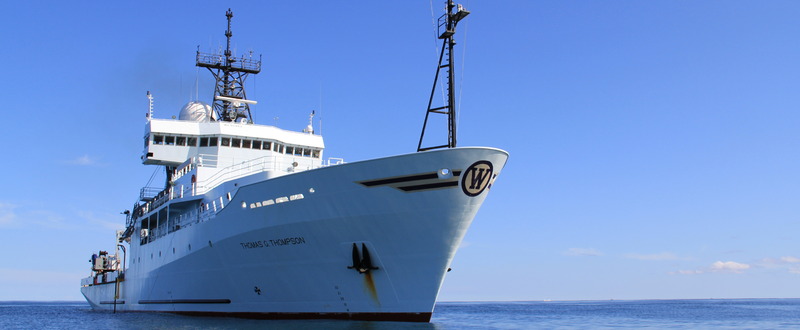
Planned route: 7 segments · ~3 days steaming · 6 stations
Operating area: Cascadia Margin off Newport out to the Juan de Fucan Ridge - Axial Seamount
›4 legs· Newport (Oregon) - United States → Newport (Oregon) - United States
- 1Newport (Oregon) - United States→Newport (Oregon) - United StatesAug 14 – Aug 22, 2023 · 8 d
- 2Newport (Oregon) - United States→Newport (Oregon) - United StatesAug 24 – Aug 29, 2023 · 5 d
- 3Newport (Oregon) - United States→Newport (Oregon) - United StatesSep 1 – Sep 7, 2023 · 5 d
- 4Newport (Oregon) - United States→Newport (Oregon) - United StatesSep 9 – Sep 18, 2023 · 10 d
University of Washington
Projects aboard (6)
Axial Acoustic Array
Axial Volcano is one of the most extensively studied sites on the global network of mid-ocean ridges. Three eruptions have been observed in 1998, 2011 and 2015 with a near continuous 20-year record of vertical geodesy from bottom pressure sensors in the caldera recording cycles of inflation and rapid syn-eruptive deflation. Axial volcano has also been the focus of several seismic imaging studies including a recent three-dimensional seismic reflection experiment that provide a remarkably detailed view of the magmatic system. In comparison, the geodetic models of inflation are limited in complexity and resolution by the small number of geodetic sites and the difficulty distinguishing distributed inflation from fault motion on the buried outward dipping ring faults using vertical geodesy alone. Here we propose to install a 10-year 4 station acoustic network at Axial that range between each pair of transponders and include a pressure gauge, temperature, salinity and velocimetry sensors. One station will be connected to the OOI Regional Cabled Array enabling real time acquisition of data. The primary scientific objective is to measure horizontal extension rates across and within the caldera that can be combined with the other geodetic observations to (1) discriminate between distributed inflation and motion on the buried outward dipping faults beneath the east and west caldera walls and thus, understand the pattern of seismic coupling on these faults throughout the eruptive cycle; (2) contribute data that can enable more complex models of inflation and (3) obtain measurement of the dike with for dikes that propagate across the acoustic baseline. A secondary objective is to provide an acoustic network that can support future efforts to demonstrate and optimize remote communication and navigation of autonomous underwater vehicles.
People aboard
Axial Acoustic Array
- William Wilcock · Principal investigator
CAREER Vent Micro 2023
- Rika Anderson · Principal investigator
Heat flow at ASHES
- Karen Bemis · Principal investigator
- Karen Bemis · Chief scientist
OOI RCA Cruise
- Deborah Kelley · Principal investigator
Phase 2 Enhancements 2023
- Bill Chadwick · Principal investigator
MARUM - M3
- Deborah Kelley · Principal investigator
Party size: 36
Estimated vacant berths: 0
Equipment
Aboard the vessel
- Underway Seawater System
- pCO2
- Meteorological Data
- ADCP/UHDAS – range 500-750m (e.g. 75kHz)
- Multibeam - Mid-Water (EM302/304)
- Ultra-Short Base-Line Acoustic Navigation System
- Dynamic Positioning (DP)
- Dynamic Positioning (DP)
- Dynamic Positioning (DP)
- Underway Seawater System
- pCO2
- Meteorological Data
- Ultra-Short Base-Line Acoustic Navigation System
- ADCP/UHDAS – range < 80m (eg. 300kHz)
- Multibeam - Deep Water (EM122, EM124)
- Echosounder, 12kHz
Pooled / portable
- CTD
- Other Seafloor Sampling Equipment
Science party brings
- Science-provided vans
Schedule data from UNOLS Marine Facilities Planning · operator cruise code TN-422 OOI RCA 2023 · MFP references 21/430, 21/613, 21/110, 22/1551, 21/241, 22/1566 · synced Sep 30, 2026