Arctic Chief Sci Training Cruise (attached to transit)
Completed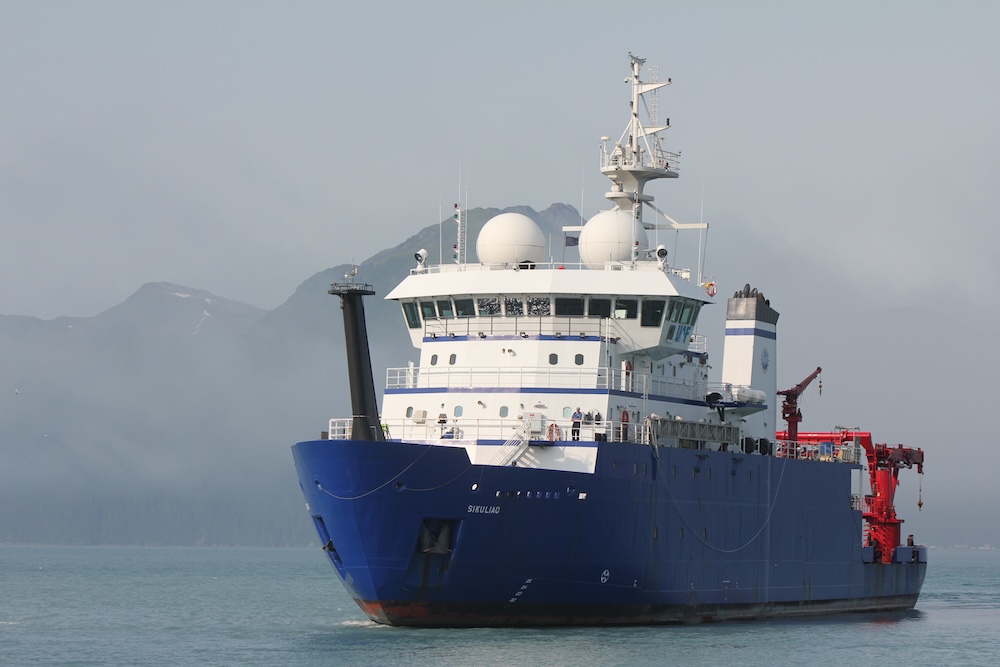
Planned route: 12 segments · ~5 days steaming · 11 stations
Operating area: Bering Sea
Route: Seward (Alaska) - United States → Nome (Alaska) - United States
Projects aboard (2)
Arctic Chief Sci Training Cruise (attached to transit)
The National Science Foundation supports a fleet of research vessels dedicated to scientific investigations, including the R/V Sikuliaq which is tailored for Arctic work. Through partnerships, NSF-funded scientists also have access to work on other research vessels such as the USCGC Healy . Conducting successful research cruises on these vessels requires that PIs understand the logistics of requesting ship time, mobilizing equipment and personnel, effectively planning for underway operations in concert with ship staff, and managing personnel and sampling plans at sea—as well as unexpected issues that arise. In order to maintain a robust scientific workforce who can effectively utilize these seagoing platforms, early career scientists need to gain training and experience in navigating these processes and logistics. There is a particular need for this training and capacity-building at the present time, given increasing arctic research interests and a lag in research cruises (and thus junior scientist training) during the covid-19 pandemic. In this proposal we seek to host 12 early career participants on a week-long already-scheduled R/V Sikuliaq transit between Seward and Nome, AK, with an added day for scientific sampling opportunities. Participants will be recruited through an advertisement process, and introduced to the UNOLS system and cruise logistics through several pre-cruise meetings held virtually in the spring. Participants will have the opportunity to plan their sampling, communicate plans with the vessel crew, and mobilize supplies prior to the trip. The trip will include a one-day pre-trip workshop where they will learn more information about navigating the UNOLS system and will make final departure preparations. During the course of the cruise, four science mentors and vessel scientific staff will provide guidance and lead a series of presentations and discussions about how to manage a successful survey. After the survey, participants will ship any samples home, archive data, and create a cruise report. This effort is modeled after a series of five successful chief scientist training cruises hosted in the past decade in non-polar environments.
People aboard
Arctic Chief Sci Training Cruise (attached to transit)
- Emily Eidam OLD ACCOUNT · Principal investigator
Transit - Seward to Nome
- Doug Baird · Principal investigator
Party size: 16
Estimated vacant berths: 8
Equipment
Aboard the vessel
- Ship Fitted Winches & Wires
- Overboarding Cable - Fiber Optic
- Crane
- Stern A-Frame
- Navigation - Heading/Position
- Dynamic Positioning (DP)
- Underway Seawater System
- pCO2
- Meteorological Data
- Echosounder, 12kHz
- Echosounder, 3.5kHz CHIRP
- ADCP/UHDAS – range < 80m (eg. 300kHz)
- ADCP/UHDAS – range 250-350m (e.g. 150kHz)
- Multibeam - Shallow-water (EM710/712/2040/Seabat 7100)
- Biological multi-frequency echosounder - EK80
- Science (Wave/Ice) Radar
Pooled / portable
- CTD
- XBT
- Sediment Core
- Grab Sampler
- Other Seafloor Sampling Equipment
Schedule data from UNOLS Marine Facilities Planning · operator cruise code SKQ202309T · MFP references 22/2526, 22/2665 · synced Sep 30, 2026