UMCES ChesBay Plume
Completed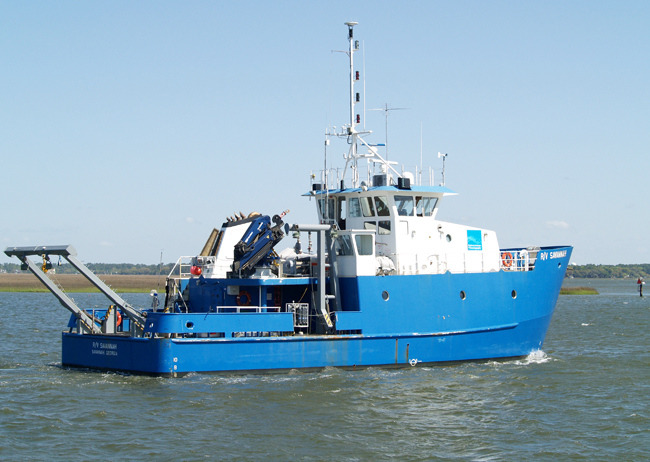
Planned route: 29 segments · ~2 days steaming · 28 stations
Operating area: Chesapeake Bay mouth and adjacent shelf waters
Route: Norfolk (Virginia) - United States → Savannah (Georgia) - United States
Project aboard
There is a clear need to develop our understanding of how plumes affect the benthic component of shallow, temperate shelf ecosystems, particularly in regards to the benthic faunal communities. The benthos plays a key role in the dynamics of plume-shelf systems, acting to assimilate deposited allochthonous and autochthonous particulate organic matter (POM), modulate local biogeochemical fluxes and cycling, and fill a critical ecological function as forage for higher trophic levels. Despite evidence of the importance of these benthic communities in contributing to ecosystem dynamics in these shelf environments, a mechanistic understanding of how these communities are structured spatially and temporally in response to plume inputs or how biologically-mediated processes such as nutrient flux rates covary with benthic communities across plume gradients, remain critical knowledge gaps. The overarching goal for this project is to determine how the magnitude and reactivity of organic matter inputs and environmental conditions associated with a large, spatially and temporally dynamic estuarine plume affects an inner continental shelf benthic community. We specifically seek to quantify the benthic community response to seasonally and spatially variable patterns of organic matter deposition, both labile and refractory, associated with plume conditions. We will use a combination of observational and experimental approaches to quantify the history of plume-driven conditions and particle transport and deposition and then quantify through experiments and numerical model simulations how the magnitude and reactivity of POM deposited to sediments controls the structure and metabolism of the benthic community. We will use these approaches to address hypotheses that predict benthic biomass, biodiversity, and secondary production to be stimulated by POM inputs both seasonally and spatially, but this stimulation will be modulated by feeding mode, past exposure to plume influence, lability of depositing organic matter, and physical forces (e.g., temperature, salinity, bed stress) imposed by hydrodynamic variations. Our project blends aspects of benthic ecology, biogeochemistry, and coastal hydrodynamics in an effort that merges discrete observations, incubation experiments, and numerical modeling in a synthesis that will deliver new insights into the role of benthic communities in responding to – and influencing – plume-coastal ocean interactions. The proposed research will help fill these knowledge gaps by identifying key relationships between plume-associated conditions and benthic community structures and processes, and experimentally testing associated ecological and biogeochemical rates. This knowledge is central to accurately coupling estuary-ocean food web models and is becoming ever more pressing in the face of anthropogenic pressures given long-term shifts in regional climate and the changing frequency and severity of extreme weather events in many regions. In addition to advancing our scientific understanding of plume-shelf dynamics, this project will provide STEM training directly to early career scientists and students from a variety of backgrounds. The PIs will leverage an established collaborative internship program with a regional community college to offer hands-on STEM learning opportunities to students from historically underserved segments of the undergraduate population (e.g., first generation students, students of color). Non-biological STEM undergraduates in a computer science course will be engaged through a focused video game design project in which students design, program and present a video game that models a central element of the project as a tool for engaging the public. Several National Science Foundation-funded Research Experience for Undergraduates (REU) fellows will be invited to participate in this project with tailored summer projects that incorporate aspects of this proposal and the REU's own interests. Training opportunities will be provided to the graduate student to develop mentoring skills through direct interaction with undergraduate interns, and to practice science communication through public outreach activities on and off-campus. In addition to training the next generation of scientists, this research will be shared with regional fisheries management groups to ensure relevant information (e.g., drivers of inner shelf benthic forage availability) is available for ecosystem-based management applications and with the general public through seminars and structured interactive events (e.g., institutional open house events).
People aboard
- Jeremy Testa · Chief scientist
- Ryan J. Woodland · Chief scientist
- Ryan J. Woodland · Principal investigator
Party size: 9
Estimated vacant berths: 11
Equipment
Aboard the vessel
- Ship Fitted Winches & Wires
- Overboarding Cable - Fiber Optic
- Stern A-Frame
Pooled / portable
- CTD
- Other Seafloor Sampling Equipment
- Portable Laboratory Van(s) - NSF Van Pool
Schedule data from UNOLS Marine Facilities Planning · operator cruise code CBL · MFP reference 23/3513 · synced Sep 24, 2026