INST
Clark Alexander · SkIO
Ship time dedicated to facilitate experiential learning for UGA and USG graduate and undergraduate students.
Jun 26 – Jun 27, 2026 · 1 d
South Atlantic Bight - USA
UNOLS
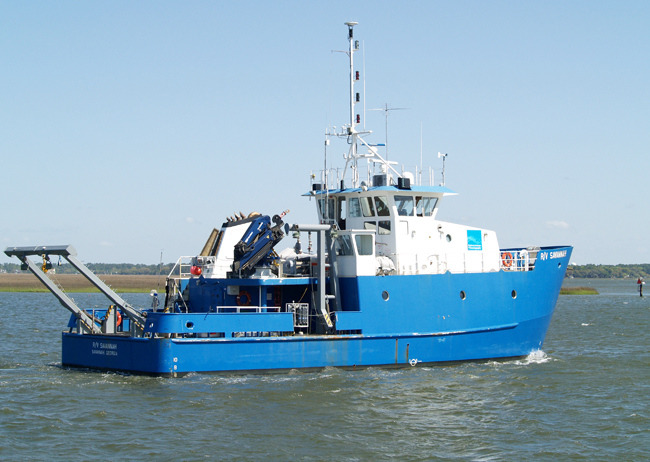 USASKIO
Oceanographic Studiees in Estuarine and Continental shelf
Oct 2025 – Oct 2026 · 25 port calls · 125 at-sea periods
20
Research bunks
27.9 m
Length
9 kn
Cruise speed
10
Endurance
4
Crew
12+ past · 22 upcoming
Clark Alexander · SkIO
Ship time dedicated to facilitate experiential learning for UGA and USG graduate and undergraduate students.
Jun 26 – Jun 27, 2026 · 1 d
South Atlantic Bight - USA
Nathan Bacheler · NOAA
SEFIS is a fishery-independent research group that surveys reef fish using traps and video from Cape Hatteras, NC, to St. Lucie Inlet, FL, from 15-115 m deep.
Jul 1 – Jul 10, 2026 · 9 d
Southeast US Atlantic continental shelf between NC and the east coast of FL.
Nathan Bacheler · NOAA
SEFIS is a fishery-independent research group that surveys reef fish using traps and video from Cape Hatteras, NC, to St. Lucie Inlet, FL, from 15-115 m deep.
Jul 22 – Jul 31, 2026 · 9 d
Southeast US Atlantic continental shelf between NC and the east coast of FL.
Marc Frischer · UGA
Organism aggregation, resource patchiness, and layering have long been recognized as fundamental ecosystem properties, especially in dynamic marine pelagic systems. However, integrating fine-scale (1-10 m) water column structure into our understanding of the forces that regulate marine ecosystems has proved challenging. Specifically, an overwhelming majority of marine organisms (plankton) experience their environment at fine spatial scales, which are difficult to sample, yet most measurements of chemical and biological parameters that define the structure of food webs and the flow of energy are averaged over much larger portions of the water column. This mismatch hinders our ability to understand the trophic consequences of fine-scale variability. Addressing this challenge will help to resolve key, and potentially predictable, sequences of events that change community structure and have trophic consequences that propagate throughout the food web in productive continental shelf environments. To address this knowledge gap will conduct ambitious field campaign in two shelf ecosystems with similar zooplankton taxa yet contrasting oceanographic regimes. Sampling will encompass two seasons (summer and winter) with contrasting degrees of stratification. Innovative molecular and stable-isotope measurements will allow for a robust coupling to oceanographic features and zooplankton abundance and community composition, elucidating the trophic consequences of wather column structure.
Aug 4 – Aug 12, 2026 · 8 d
South Atlantic Bight middle shelf
Martial Taillefert · GaTech
Collect sediment, water samples, and CTD data, deploy ring net tows, and collect sea surface data around Skidaway Island, the Savannah River, and along an offshore transect (weather and time permitting). Graduate students of this interdisciplinary Ocean Science and Engineering (OSE) group will be learning how samples are collected at sea and explore some of the physical, biological, and chemical variations in the South Atlantic Bight.
Aug 15 – Aug 16, 2026 · 1 d
NA-6 - kidaway River; Wilmington River; Continental shelf off Georgia; Savannah River; Bull River and return
Nathan Bacheler · NOAA
SEFIS is a fishery-independent research group that surveys reef fish using traps and video from Cape Hatteras, NC, to St. Lucie Inlet, FL, from 15-115 m deep.
Aug 19 – Aug 28, 2026 · 9 d
Southeast US Atlantic continental shelf between NC and the east coast of FL.
Nathan Bacheler · NOAA
SEFIS is a fishery-independent research group that surveys reef fish using traps and video from Cape Hatteras, NC, to St. Lucie Inlet, FL, from 15-115 m deep.
Sep 2 – Sep 12, 2026 · 9 d
Southeast US Atlantic continental shelf between NC and the east coast of FL.
Marc Frischer · UGA
Sep 18 – Sep 20, 2026 · 1 d
Wassaw Sound estuarine and South Atlantic Bight Inner shelf (Gray's Reef)
Jeff Pietro · WHOI
The cruise is dedicated to the retrieval of our Multi-Function Node stuck on the seafloor off Savannah.
Sep 22 – Sep 24, 2026 · 1 d
31° 49.5921' N 080° 17.8098' W
Clark Alexander · SkIO
Ship time dedicated to facilitate experiential learning for UGA and USG graduate and undergraduate students.
Sep 26 – Sep 28, 2026 · 1 d
South Atlantic Bight - USA
Janet Nye · UNC
The continental shelf near Cape Hatteras, NC is one of the strongest biogeographic barriers in the ocean. However, the processes that allow transport from the south to the north against the prevailing equatorward currents are poorly understood Transport of marine organisms across convergence zones is key to understanding the deterrents to biodiversity shifts in the coastal ocean. The purpose of this work is to determine the dominant mechanisms of shifts from the South Atlantic Bight to the Mid-Atlantic Bight (SAB2MAB) by conducting the first comprehensive ichthyoplankton surveys in this region in over twenty years and combining observations with state-of-the-art spatio-temporal modeling. Since little to no data on egg and larval distribution exist in this region and the existing data are decades old, current data on fish egg and larval distribution are needed to generate current spawning index maps and to compare to model results of potential and realized connectivity. Our field sampling will compare cool vs. warm season transport and connectivity from the SAB to MAB. We propose to conduct four cruises over two years, one in each season.
Oct 6 – Oct 16, 2026 · 10 d
Western North Atlantic off the US east coast of NC
Bradley Tolar · UNCW
TEAL-SHIPS (Transect Expedition to Assess Land-to-Sea Habitats via Interdisciplinary Process Studies) seeks to characterize the ecological processes across a diverse environmental gradient. Our team consists of physical, chemical, and biological oceanographers and students. Funded by the University of North Carolina (UNC) System Research Opportunities Initiative (ROI), TEAL-SHIPS has initiated collaborations across multiple institutions in our state to conduct eight research cruises seasonally over two years, from the mouth of the Cape Fear River (near Wilmington, NC, USA) to the Gulf Stream. Thus far, we have completed five cruises on board the R/V Cape Hatteras , managed by the Cape Fear Community College (CFCC) Marine Technology program, who are partners and collaborators in this project. On each of these previous expeditions, we have assessed coastal-to-offshore habitats across our transect including physical (e.g., temperature, salinity, oxygen, currents), chemical (e.g., chlorophyll, carbon, metabolites, nutrients), and biological (bacteria/archaea, plankton, fish) parameters from CTD casts, net tows, and trawls.
Oct 19 – Oct 23, 2026 · 4 d
US Atlantic Coast (North Carolina, Cape Fear) to Gulf Stream
Nicholas Foukal · WHOI
The plan for this project is to deploy a set of five bottom-mounted ADCPs across the Gulf Stream for a full year. We plan to directly measure the Gulf Stream volume transport and its variability along the US Southeast Coast. Previous attempts to measure the Gulf Stream have focused on the Florida Straits where the current is confined and thus easier to measure. However the Florida Current joins with the Antilles Current along the Northeast Florida shelf, creating the beginnings of the Gulf Stream proper. It is here where we plan to deploy our moorings. Our hypothesis is that most variability in the Gulf Stream strength is also reflected in tide gauges along the US Southeast coast. There is a long-term record of coastal sea level from Fernandina Beach, which will be directly inshore of our moorings. We also plan to use sea level variability from the Ft. Pulaski tide gauge station. If Gulf Stream variability is correlated to coastal sea level, this offers the possibility to reconstruct Gulf Stream variability going back over 100 years.
Nov 2 – Nov 7, 2026 · 4 d
Fernandina Beach cross section
Marc Frischer · UGA
Nov 13 – Nov 15, 2026 · 1 d
Wassaw Sound estuarine and South Atlantic Bight Inner shelf (15 m isobath at 31.4N)
Xuefeng (Nick) Peng · SC
Marine fungi are an under sampled but increasingly recognized component of the ocean’s carbon cycle. Our project will sail to the productive South Atlantic Bight to ask how fungi interact with bacteria to decompose zooplankton- and phytoplankton- derived carbon substrates such as cellulose and chitosan. By combining metagenomics, metatranscriptomics and quantitative DNA stable isotope probing (DNA-SIP) we will determine which fungal and bacterial lineages express genes encoding hydrolytic enzymes, trace their incorporation of 13C-labeled substrates, and test whether these interactions accelerate carbon turnover. Shipboard work will be tightly integrated with shore-based enzyme biochemistry and co-culture experiments. Insights will reveal whether fungi merely compete with bacteria for carbon or form synergistic networks that stabilize microbial communities against environmental change, ultimately improving model predictions of carbon export efficiency. The cruise also serves as a training platform for undergraduate and graduate students through a vertically integrated education plan that links laboratory, field, and bioinformatic skill building.
Jan 5 – Jan 7, 2027 · 2 d
South Atlantic Bight
Janet Nye · UNC
The continental shelf near Cape Hatteras, NC is one of the strongest biogeographic barriers in the ocean. However, the processes that allow transport from the south to the north against the prevailing equatorward currents are poorly understood Transport of marine organisms across convergence zones is key to understanding the deterrents to biodiversity shifts in the coastal ocean. The purpose of this work is to determine the dominant mechanisms of shifts from the South Atlantic Bight to the Mid-Atlantic Bight (SAB2MAB) by conducting the first comprehensive ichthyoplankton surveys in this region in over twenty years and combining observations with state-of-the-art spatio-temporal modeling. Since little to no data on egg and larval distribution exist in this region and the existing data are decades old, current data on fish egg and larval distribution are needed to generate current spawning index maps and to compare to model results of potential and realized connectivity. Our field sampling will compare cool vs. warm season transport and connectivity from the SAB to MAB. We propose to conduct four cruises over two years, one in each season.
Jan 12 – Jan 22, 2027 · 10 d
Western North Atlantic off the US east coast of NC
Bradley Tolar · UNCW
TEAL-SHIPS (Transect Expedition to Assess Land-to-Sea Habitats via Interdisciplinary Process Studies) seeks to characterize the ecological processes across a diverse environmental gradient. Our team consists of physical, chemical, and biological oceanographers and students. Funded by the University of North Carolina (UNC) System Research Opportunities Initiative (ROI), TEAL-SHIPS has initiated collaborations across multiple institutions in our state to conduct eight research cruises seasonally over two years, from the mouth of the Cape Fear River (near Wilmington, NC, USA) to the Gulf Stream. Thus far, we have completed five cruises on board the R/V Cape Hatteras , managed by the Cape Fear Community College (CFCC) Marine Technology program, who are partners and collaborators in this project. On each of these previous expeditions, we have assessed coastal-to-offshore habitats across our transect including physical (e.g., temperature, salinity, oxygen, currents), chemical (e.g., chlorophyll, carbon, metabolites, nutrients), and biological (bacteria/archaea, plankton, fish) parameters from CTD casts, net tows, and trawls.
Mar 15 – Mar 20, 2027 · 4 d
US Atlantic Coast (North Carolina, Cape Fear) to Gulf Stream
Janet Nye · UNC
The continental shelf near Cape Hatteras, NC is one of the strongest biogeographic barriers in the ocean. However, the processes that allow transport from the south to the north against the prevailing equatorward currents are poorly understood Transport of marine organisms across convergence zones is key to understanding the deterrents to biodiversity shifts in the coastal ocean. The purpose of this work is to determine the dominant mechanisms of shifts from the South Atlantic Bight to the Mid-Atlantic Bight (SAB2MAB) by conducting the first comprehensive ichthyoplankton surveys in this region in over twenty years and combining observations with state-of-the-art spatio-temporal modeling. Since little to no data on egg and larval distribution exist in this region and the existing data are decades old, current data on fish egg and larval distribution are needed to generate current spawning index maps and to compare to model results of potential and realized connectivity. Our field sampling will compare cool vs. warm season transport and connectivity from the SAB to MAB. We propose to conduct four cruises over two years, one in each season.
Apr 6 – Apr 16, 2027 · 10 d
Western North Atlantic off the US east coast of NC
Christopher LaClair · UNCW
Replacement of currently deployed met/oce buoys and moorings. PI will transport buoys to RV Sav prior to cruise. Planned buoys for replacement are PNC, FTP and FRP2.
May 4 – May 8, 2027 · 3 d
Coastal Waters of South Carolina, Georgia and Florida.
SARA RIVERO CALLE · UGA
The overarching goal of this project is to understand phytoplankton dynamics, community composition and NCP to examine carbon dynamics on a continental shelf. The US Southeastern continental shelf of South Atlantic Bight (SAB) can be viewed as a model system providing new insights on ocean optics, biogeochemistry, carbon dynamics that are applicable to other continental shelves. This study will represent the first high-resolution large-scale investigation of the phytoplankton community composition, carbon dynamics and net community production variability in optically complex waters. This proposal will enhance the NSF educational goals by developing hands-on trainings (for educators, early career scientists, and undergraduates) that hinge on the shared-use nature of data and instrumentation. The requested cruise time will allow us to collect a large amount of biogeochemical data at times and locations for which we do not have as much information, filling in gaps, while also providing an opportunity for the participants in the two proposed trainings to gain hands-on experience collecting oceanographic data and learning how to use and interpret data from NSF shared use instrumentation that will be taught in the trainings
May 11 – May 20, 2027 · 9 d
Southeast US Atlantic continental shelf between NC and the east coast of FL.
Nathan Bacheler · NOAA
SEFIS is a fishery-independent research group that surveys reef fish using traps and video from Cape Hatteras, NC, to St. Lucie Inlet, FL, from 15-115 m deep.
May 11 – May 20, 2027 · 9 d
Southeast US Atlantic continental shelf between NC and the east coast of FL.
Laura Treible · SSU
This project is part of a summer REU program in marine sciences in Savannah, Georgia, that emphasizes early undergraduate participation (freshmen and sophomore), to target students during a critical time in their STEM career. This REU provides a first research experience to bright young scientists who are not traditionally considered for an REU, and includes a 2-day research cruise opportunity. This opportunity to conduct high-quality oceanographic research is in an environment that is accommodating, nurturing, and educationally broad. In targeting students with no prior research experience, the REU provides them with new skills and yields small cohorts of the next generation of research oceanographers. The broad range of faculty mentor qualifications, experience, and facilities provides additional intellectual merit, thus broadening each participant’s experience. The cruise will include all the participants, PI, co-PI, graduate assistant, and additional faculty mentors whose research utilizes coastal/estuarine field sampling. The cruise provides participants with direct, collaborative experience working with the science and ship’s crew, off-shore sampling and data collection, and common oceanographic instrumentation and equipment (e.g., CTD, plankton nets). These experiences provide opportunities for interns to develop research questions but also serve as a common bonding experience for all the students conducting science together.
Jun 1 – Jun 2, 2027 · 1 d
Georgia Bight
Nathan Bacheler · NOAA
SEFIS is a fishery-independent research group that surveys reef fish using traps and video from Cape Hatteras, NC, to St. Lucie Inlet, FL, from 15-115 m deep.
Jun 8 – Jun 17, 2027 · 9 d
Southeast US Atlantic continental shelf between NC and the east coast of FL.
Janet Nye · UNC
The continental shelf near Cape Hatteras, NC is one of the strongest biogeographic barriers in the ocean. However, the processes that allow transport from the south to the north against the prevailing equatorward currents are poorly understood Transport of marine organisms across convergence zones is key to understanding the deterrents to biodiversity shifts in the coastal ocean. The purpose of this work is to determine the dominant mechanisms of shifts from the South Atlantic Bight to the Mid-Atlantic Bight (SAB2MAB) by conducting the first comprehensive ichthyoplankton surveys in this region in over twenty years and combining observations with state-of-the-art spatio-temporal modeling. Since little to no data on egg and larval distribution exist in this region and the existing data are decades old, current data on fish egg and larval distribution are needed to generate current spawning index maps and to compare to model results of potential and realized connectivity. Our field sampling will compare cool vs. warm season transport and connectivity from the SAB to MAB. We propose to conduct four cruises over two years, one in each season.
Jun 22 – Jul 3, 2027 · 10 d
Western North Atlantic off the US east coast of NC
Nathan Bacheler · NOAA
SEFIS is a fishery-independent research group that surveys reef fish using traps and video from Cape Hatteras, NC, to St. Lucie Inlet, FL, from 15-115 m deep.
Jul 6 – Jul 15, 2027 · 9 d
Southeast US Atlantic continental shelf between NC and the east coast of FL.
Xuefeng (Nick) Peng · SC
Marine fungi are an under sampled but increasingly recognized component of the ocean’s carbon cycle. Our project will sail to the productive South Atlantic Bight to ask how fungi interact with bacteria to decompose zooplankton- and phytoplankton- derived carbon substrates such as cellulose and chitosan. By combining metagenomics, metatranscriptomics and quantitative DNA stable isotope probing (DNA-SIP) we will determine which fungal and bacterial lineages express genes encoding hydrolytic enzymes, trace their incorporation of 13C-labeled substrates, and test whether these interactions accelerate carbon turnover. Shipboard work will be tightly integrated with shore-based enzyme biochemistry and co-culture experiments. Insights will reveal whether fungi merely compete with bacteria for carbon or form synergistic networks that stabilize microbial communities against environmental change, ultimately improving model predictions of carbon export efficiency. The cruise also serves as a training platform for undergraduate and graduate students through a vertically integrated education plan that links laboratory, field, and bioinformatic skill building.
Jul 20 – Jul 23, 2027 · 3 d
South Atlantic Bight
Janet Nye · UNC
The continental shelf near Cape Hatteras, NC is one of the strongest biogeographic barriers in the ocean. However, the processes that allow transport from the south to the north against the prevailing equatorward currents are poorly understood Transport of marine organisms across convergence zones is key to understanding the deterrents to biodiversity shifts in the coastal ocean. The purpose of this work is to determine the dominant mechanisms of shifts from the South Atlantic Bight to the Mid-Atlantic Bight (SAB2MAB) by conducting the first comprehensive ichthyoplankton surveys in this region in over twenty years and combining observations with state-of-the-art spatio-temporal modeling. Since little to no data on egg and larval distribution exist in this region and the existing data are decades old, current data on fish egg and larval distribution are needed to generate current spawning index maps and to compare to model results of potential and realized connectivity. Our field sampling will compare cool vs. warm season transport and connectivity from the SAB to MAB. We propose to conduct four cruises over two years, one in each season.
Oct 5 – Oct 15, 2027 · 10 d
Western North Atlantic off the US east coast of NC
Xuefeng (Nick) Peng · SC
Marine fungi are an under sampled but increasingly recognized component of the ocean’s carbon cycle. Our project will sail to the productive South Atlantic Bight to ask how fungi interact with bacteria to decompose zooplankton- and phytoplankton- derived carbon substrates such as cellulose and chitosan. By combining metagenomics, metatranscriptomics and quantitative DNA stable isotope probing (DNA-SIP) we will determine which fungal and bacterial lineages express genes encoding hydrolytic enzymes, trace their incorporation of 13C-labeled substrates, and test whether these interactions accelerate carbon turnover. Shipboard work will be tightly integrated with shore-based enzyme biochemistry and co-culture experiments. Insights will reveal whether fungi merely compete with bacteria for carbon or form synergistic networks that stabilize microbial communities against environmental change, ultimately improving model predictions of carbon export efficiency. The cruise also serves as a training platform for undergraduate and graduate students through a vertically integrated education plan that links laboratory, field, and bioinformatic skill building.
Jan 4 – Jan 14, 2028 · 10 d
Western North Atlantic off the US east coast of NC
Janet Nye · UNC
The continental shelf near Cape Hatteras, NC is one of the strongest biogeographic barriers in the ocean. However, the processes that allow transport from the south to the north against the prevailing equatorward currents are poorly understood Transport of marine organisms across convergence zones is key to understanding the deterrents to biodiversity shifts in the coastal ocean. The purpose of this work is to determine the dominant mechanisms of shifts from the South Atlantic Bight to the Mid-Atlantic Bight (SAB2MAB) by conducting the first comprehensive ichthyoplankton surveys in this region in over twenty years and combining observations with state-of-the-art spatio-temporal modeling. Since little to no data on egg and larval distribution exist in this region and the existing data are decades old, current data on fish egg and larval distribution are needed to generate current spawning index maps and to compare to model results of potential and realized connectivity. Our field sampling will compare cool vs. warm season transport and connectivity from the SAB to MAB. We propose to conduct four cruises over two years, one in each season.
Apr 4 – Apr 14, 2028 · 10 d
Western North Atlantic off the US east coast of NC
Janet Nye · UNC
The continental shelf near Cape Hatteras, NC is one of the strongest biogeographic barriers in the ocean. However, the processes that allow transport from the south to the north against the prevailing equatorward currents are poorly understood Transport of marine organisms across convergence zones is key to understanding the deterrents to biodiversity shifts in the coastal ocean. The purpose of this work is to determine the dominant mechanisms of shifts from the South Atlantic Bight to the Mid- Atlantic Bight (SAB2MAB) by conducting the first comprehensive ichthyoplankton surveys in this region in over twenty years and combining observations with state-of-the-art spatio-temporal modeling. Since little to no data on egg and larval distribution exist in this region and the existing data are decades old, current data on fish egg and larval distribution are needed to generate current spawning index maps and to compare to model results of potential and realized connectivity. Our field sampling will compare cool vs. warm season transport and connectivity from the SAB to MAB. We propose to conduct four cruises over two years, one in each season.
Jul 1 – Jul 11, 2028 · 10 d
Western North Atlantic off the US east coast of NC
Xuefeng (Nick) Peng · SC
Marine fungi are an under sampled but increasingly recognized component of the ocean’s carbon cycle. Our project will sail to the productive South Atlantic Bight to ask how fungi interact with bacteria to decompose zooplankton- and phytoplankton- derived carbon substrates such as cellulose and chitosan. By combining metagenomics, metatranscriptomics and quantitative DNA stable isotope probing (DNA-SIP) we will determine which fungal and bacterial lineages express genes encoding hydrolytic enzymes, trace their incorporation of 13C-labeled substrates, and test whether these interactions accelerate carbon turnover. Shipboard work will be tightly integrated with shore-based enzyme biochemistry and co-culture experiments. Insights will reveal whether fungi merely compete with bacteria for carbon or form synergistic networks that stabilize microbial communities against environmental change, ultimately improving model predictions of carbon export efficiency. The cruise also serves as a training platform for undergraduate and graduate students through a vertically integrated education plan that links laboratory, field, and bioinformatic skill building.
Jul 10 – Jul 13, 2028 · 3 d
South Atlantic Bight
Xuefeng (Nick) Peng · SC
Marine fungi are an under sampled but increasingly recognized component of the ocean’s carbon cycle. Our project will sail to the productive South Atlantic Bight to ask how fungi interact with bacteria to decompose zooplankton- and phytoplankton- derived carbon substrates such as cellulose and chitosan. By combining metagenomics, metatranscriptomics and quantitative DNA stable isotope probing (DNA-SIP) we will determine which fungal and bacterial lineages express genes encoding hydrolytic enzymes, trace their incorporation of 13C-labeled substrates, and test whether these interactions accelerate carbon turnover. Shipboard work will be tightly integrated with shore-based enzyme biochemistry and co-culture experiments. Insights will reveal whether fungi merely compete with bacteria for carbon or form synergistic networks that stabilize microbial communities against environmental change, ultimately improving model predictions of carbon export efficiency. The cruise also serves as a training platform for undergraduate and graduate students through a vertically integrated education plan that links laboratory, field, and bioinformatic skill building.
Jan 8 – Jan 10, 2029 · 2 d
South Atlantic Bight
SARA RIVERO CALLE · UGA
The overarching goal of this project is to understand phytoplankton dynamics, community composition and NCP to examine carbon dynamics on a continental shelf. The US Southeastern continental shelf of South Atlantic Bight (SAB) can be viewed as a model system providing new insights on ocean optics, biogeochemistry, carbon dynamics that are applicable to other continental shelves. This study will represent the first high-resolution large-scale investigation of the phytoplankton community composition, carbon dynamics and net community production variability in optically complex waters. This proposal will enhance the NSF educational goals by developing hands-on trainings (for educators, early career scientists, and undergraduates) that hinge on the shared-use nature of data and instrumentation. The requested cruise time will allow us to collect a large amount of biogeochemical data at times and locations for which we do not have as much information, filling in gaps, while also providing an opportunity for the participants in the two proposed trainings to gain hands-on experience collecting oceanographic data and learning how to use and interpret data from NSF shared use instrumentation that will be taught in the trainings
May 16, 2029 · 1 d
South Atlantic Bight
Are you the operator of this vessel?