DDT Food Webs
Completed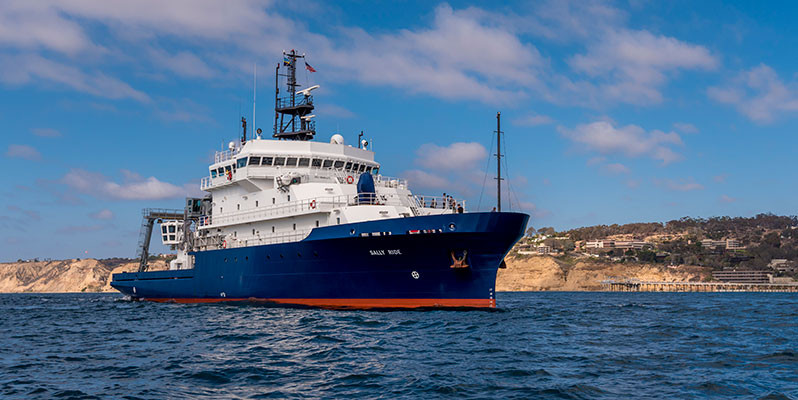
Planned route: 8 segments · ~27 hours steaming · 4 stations
Operating area: Southern California Bight
Route: San Diego (California) - United States → San Diego (California) - United States
Scripps Institution of Oceanography
Project aboard
Historical DDT data exists for the Palos Verdes Shelf sediments, which was long believed to be the primary source of DDT and its breakdown products to the marine food web in the Southern California Bight. Scientists will thoroughly characterize the relevant contaminant profiles water column and food web components at Dumpsite Two. They will use a targeted approach to quantify the major DDT-related compounds, while utilizing a broader approach to fingerprint the less well studied breakdown products of DDT. We will trace relevant contaminants into the local, deep food web near and around the dumpsite.
People aboard
- Anela Choy · Principal investigator
Party size: 23
Estimated vacant berths: 3
Equipment
Aboard the vessel
- Ship Fitted Winches & Wires
- Overboarding Cable - Fiber Optic
- Crane
- Stern A-Frame
- Navigation - Heading/Position
- Dynamic Positioning (DP)
- Meteorological Data
- ADCP/UHDAS – range < 80m (eg. 300kHz)
- ADCP/UHDAS – range 250-350m (e.g. 150kHz)
- ADCP/UHDAS – range 1000m-1200m (e.g. 38kHz)
- Multibeam - Deep Water (EM122, EM124)
- Biological multi-frequency echosounder - EK80
Pooled / portable
- CTD
- Sediment Core
- MOC-1
- MOC-10
Schedule data from UNOLS Marine Facilities Planning · operator cruise code SR2418 Choy · MFP reference 23/3300 · synced Sep 24, 2026