Cetaceans and Sonar
Completed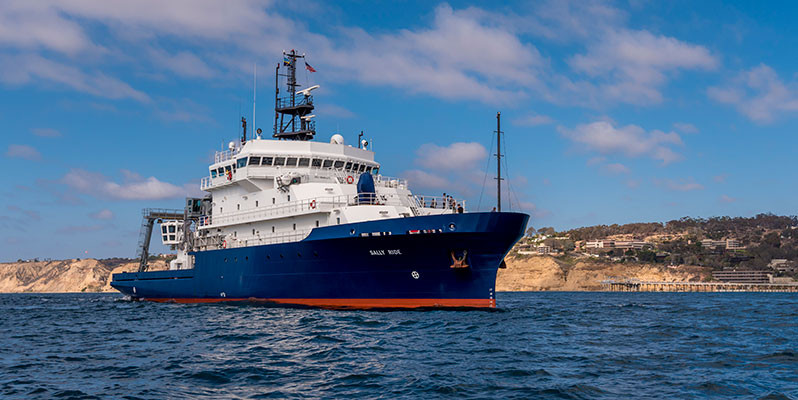
Operating area: SOCAL Bight San Diego trough, near shelf break offshore San Diego to south of Channel Islands
Route: San Diego (California) - United States → San Diego (California) - United States
Project aboard
Marine mammals inhabit a highly dynamic, mobile environment. We will document how physical oceanographic conditions drive prey distributions and cetacean response to these changes. Use of mid-frequency active sonar during US Navy training operations can invoke a cetacean behavioral response and we aim to document how a response may be shaped by underlying prey conditions. A series of 5 cruises will be conducted over the course of 2 years to record passive acoustic data on long-term moorings at sonar-impacted and minimally disturbed sites. Satellite tagging of cetaceans will provide larger spatial information on movement patterns observed outside the acoustic detection range. Information on prey will be collected with autonomous and ship-board active-acoustic systems. MOCNESS tows will provide an active acoustics ground-truth. Physical oceanographic features will be measured with autonomous sensors on the moorings and with ship-board instrumentation.
People aboard
- Simone Baumann-Pickering · Principal investigator
- Jennifer Trickey · Chief scientist
Party size: 6
Estimated vacant berths: 20
Equipment
Pooled / portable
- Winch Pool Portable Winch
Schedule data from UNOLS Marine Facilities Planning · operator cruise code SR2201 · MFP reference 22/1600 · synced Sep 24, 2026