IRISS-USV
Completed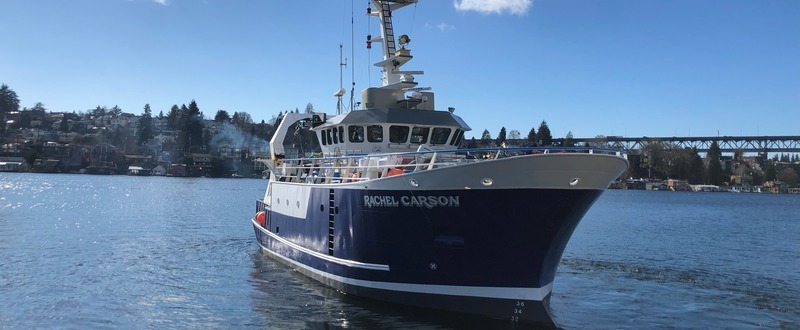
Planned route: 5 segments · ~2 days steaming
Operating area: Washington State Coast
›3 legs· Seattle (UW Pier) (Washington) - United States → Seattle (UW Pier) (Washington) - United States
- 1Seattle (UW Pier) (Washington) - United States→Westport (Washington) - United StatesJul 21 – Jul 23, 2026 · 2 d
- 2Westport (Washington) - United States→Westport (Washington) - United StatesJul 23 – Jul 24, 2026 · 1 d
- 3Westport (Washington) - United States→Seattle (UW Pier) (Washington) - United StatesJul 24 – Jul 28, 2026 · 4 d
Project aboard
The PI has developed an instrument called IRISS-OPT (InfraRed Instrument for Sea Surface temperature-Optimal Band) for measuring ocean surface skin temperature. IRISS-OPT combines a simplified one-point in situ calibration with the so-called optimal band technique. IRISS has demonstrated an accuracy comparable to the proven instrument known as ROSR (Remote Ocean Surface Radiometer). Modeled profiles of air temperature and water vapor are used to replace the sky radiance measurement. The combination of the simplified calibration and elimination of the sky measurement using IRISS-OPT now makes it practical for deployment on Uncrewed Surface Vehicles (USVs) and buoys. The proposal activity is to develop IRISS-USV, a version of IRISS-OPT for routine use on Uncrewed Surface Vehicle (USVs) and buoys. The primary activity will be to develop stand-alone versions with internal recording and optional external serial output. Two existing prototype units will be upgraded for use on a buoy. Two new units with a reduced form factor to fit on the saildrone USV will be designed and fabricated. The units will be validated at sea on a research vessel and buoys. A secondary activity will be to develop look-up tables for the atmospheric radiance needed to forego a separate sky measurement.
People aboard
- Andrew Jessup · Principal investigator
- Andrew Jessup · Chief scientist
Party size: 3
Estimated vacant berths: 10
Equipment
Aboard the vessel
- Meteorological Data
Schedule data from UNOLS Marine Facilities Planning · operator cruise code RC2026P Jessup NSF · MFP reference 25/5697 · synced Sep 24, 2026