LMP-03
Completed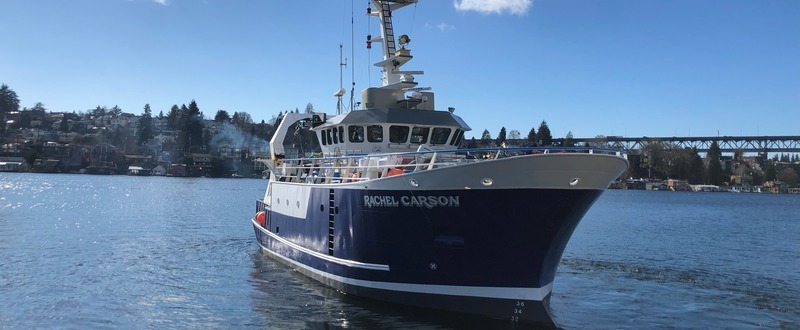
Operating area: Puget Sound Main Basin and the Hood Canal
Route: Seattle (UW Pier) (Washington) - United States → Seattle (UW Pier) (Washington) - United States
University of Washington
Project aboard
Bacteria and their viruses dominate the ocean and are important drivers of elemental cycles. Spatial and temporal differences observed in the abundances of bacteria and their viruses are the primary factor underlying hypotheses to explain the host-virus interactions that maintain these large and genetically diverse populations. Here we propose to identify additional factors that drive host-virus dynamics in the ocean by using metagenomics, cultivated systems, and models to predict conditions that activate latent phages. SAR11 are the most abundant heterotrophic bacteria in the ocean. We recently isolated the first known SAR11 cells with latent bacterial viruses (temperate phages) in their genomes (prophages). Our analyses indicate that similar phages are common in the global ocean and that they become active under carbon-limiting conditions. While this supports a growing body of evidence that temperate phages have essential roles in marine microbial ecology and biogeochemistry, it also underscores the need to identify additional variables governing host-virus relationships. This study seeks to identify specific chemical and physical parameters that activate latent phages in SAR11 cells, to elucidate the effects of these variables on the genetic networks that regulate inactive (lysogenic) and active (lytic) switching, and to model the outcomes of similar latent phages in diverse marine ecosystems. This project also represents a unique opportunity for training of a new principal investigator, a graduate student, and several underrepresented, under-privileged, and non-traditional undergraduate students from the GenOM Project at the University of Washington and the BIG Summer and PEERS programs at the University of California, Los Angeles. Oceanography is currently low-diversity and has significant barriers to entry for underrepresented students. Empowering undergraduate student collaborations and providing hands-on experience has great potential to enhance diversity in the coming years. The outreach activity we propose will introduce under-represented and non-traditional undergraduate students from both institutions to seagoing research. The educational component will also give students with computational and laboratory backgrounds an opportunity to share results and form new collaborations. This is a unique opportunity to expose students from disadvantaged communities to potentially life-changing ‘hands-on’ oceanography.
People aboard
- Robert Morris · Principal investigator
- Robert Morris · Chief scientist
Party size: 8
Estimated vacant berths: 5
Equipment
Pooled / portable
- CTD
Schedule data from UNOLS Marine Facilities Planning · operator cruise code RC-0131 LMP3 · MFP reference 21/837 · synced Sep 24, 2026