Puget Plumes
Completed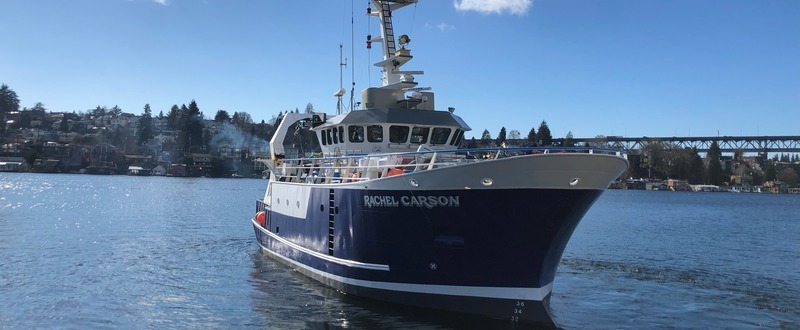
Operating area: central Puget Sound
Route: Seattle (Downtown Piers) (Washington) - United States → Seattle (Downtown Piers) (Washington) - United States
University of Washington
Project aboard
Puget Sound, the largest estuary by volume in the continental United States, has recently been observed to host large fields of active methane venting from the seafloor. Although present throughout the Sound, the majority of gas emission sites are co-located over three major fault zones that fracture the entire forearc crust of the Cascadia Subduction Zone. Multibeam and single-beam sonar data from cruises conducted in years 2011, 2018, 2019, 2020 and 2021 identified the acoustic signature of over 350 individual bubble plumes. Fluid samples from adjacent terrestrial hot springs and deep-water wells surrounding the estuary contain a helium-3 isotope signature, suggesting a deep fluid source arising from the underlying Cascadia Subduction Zone plate interface. However, limited data from our previous pilot study suggests that Puget Sound emission sites appear to lack similar helium isotope signatures expected from a deep plate-interface reservoir. As an alternative hypothesis, a shallow reservoir beneath the Holocene sediments that cover Puget Sound Eocene basement, with horizontal transfer to the thinly-sedimented Alki Point and Kingston Arch anticlines, is also possible. The origin of vigorous marine methane plumes arising from areas of thin sediment cover and associated with deeply-penetrating forearc fault zones but still presenting no thermal or chemical anomalies found in other similar forearc environments, remains an important unresolved scientific paradox. Here we propose a field sampling and monitoring program that would determine the environmental parameters responsible for the variability in the gas emissions, characterize the fluid and gas composition, and identify the sub-surface reservoir and pathways for the methane gas and vent fluid. This would allow us to better understand the role that the active fluid and gas flow play within deep regional fault zones that are a continuing seismic hazard for the urban population of the western United States.
People aboard
- Harlan Paul Johnson · Principal investigator
- Tor Bjorklund · Chief scientist
Party size: 8
Estimated vacant berths: 5
Equipment
Aboard the vessel
- Underway Seawater System
- Echosounder, 3.5kHz CHIRP
- ADCP/UHDAS – range 250-350m (e.g. 150kHz)
- Biological multi-frequency echosounder - EK60
- Ultra-Short Base-Line Acoustic Navigation System
Pooled / portable
- CTD
- Other Seafloor Sampling Equipment
- Other ROV
- WHOI MISO Camera System
Schedule data from UNOLS Marine Facilities Planning · operator cruise code RC-0090: Puget Plume · MFP reference 22/1545 · synced Sep 24, 2026