N. Atl. Porewater
Completed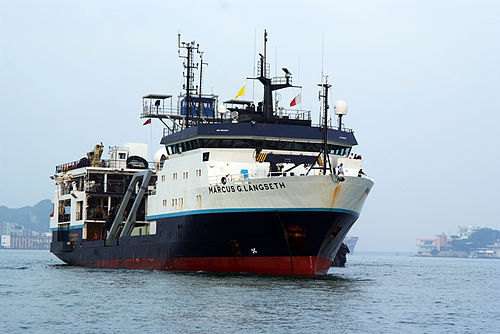
Operating area: North Atlantic
Route: Brooklyn/New York (New York) - United States → Reykjavik - Iceland
Lamont-Doherty Earth Observatory
Project aboard
Circulation of water is a fundamental trait of the oceans that impacts all aspects of its physics, chemistry and biology. However, understanding modern and past patterns of circulation – especially regarding the vast bodies of deep water – is challenging because global circulation defies direct measurement. The problems of direct measurement largely stem from the vast scales of both space and time that are of interest in understanding global circulation. One tool for estimating global circulation patterns that holds high promise is seen in neodymium isotopes (the same neodymium found in magnets is also found in the oceans at trace concentrations). These otherwise rather esoteric isotopes appear to be powerful tracers of deep ocean circulation, over a variety of timescales. Unfortunately, the elemental behavior of neodymium contrasts the isotopic behavior of neodymium in the oceans, a puzzle branded the “neodymium paradox.” This inconsistency of geochemical behavior opens to question the application of neodymium isotopes as a tracer of circulation. Here we propose to test a hypothesis that there is a yet unconstrained (even poorly identified) source of neodymium to the oceans that can explain the discrepancies seen between the elemental and isotopic neodymium marine budgets. We further seek to understand the mechanistic cause of this source and thus be able to start making global constraints on its influence. We argue that this understanding will fundamentally change our interpretations of neodymium data and allow us to more accurately quantify ocean circulation with a greater degree of confidence. Here, we propose the hypothesis that there is a benthic source of Nd to the oceans that exerts a primary control over the distribution of neodymium (Nd) and its isotopes (ε Nd ) in ocean waters, and that this benthic flux results from early diagenetic reactions that release rare earth elements (REEs; of which Nd is one) from the solid phase to pore fluid. We suggest that this flux will explain ε Nd distributions throughout the modern and past global oceans. Our research will be guided by three questions: (1) What are the mechanisms that control the magnitude and isotope composition of the benthic flux? (2) What are the relationships among bottom water, pore fluid, and the terminal solid phase compositions? Particularly, how and under what chemical conditions does an ε Nd signature become part of a preserved archival record of [Nd] and ε Nd ? (3) Can our understanding of the deep water benthic fluxes account for the integrated bottom water ε Nd as a function of apparent water mass age and circulation path (e.g., how do the pore fluid and solid phase values reconcile with the existing water column signature and water mass age data)? We propose to test these ideas by collecting sediments and their pore fluids from a diverse set of deep sea sites (7 North Atlantic sites) that reflect: carbonate-, terrigenous-, volcaniclastic- and siliceous-sediment. We will then fully characterize the physical and geochemical environment of the upper sediments and overlying water column at these sites. These analyses will include: major/minor/trace metal analyses; Nd isotopes; carbonate chemistry; O 2 /Nutrients/POC/PON; 14 C; porosity/grain size; etc. We will add these data to test a quantitative numeric geochemical model aimed at capturing the cardinal controls over the benthic source. Our goal is to offer an entirely new interpretive framework for Nd and ε Nd , such that we can offer quantitative estimates of benthic fluxes for use in models of global circulation. This work has potentially transformative implications on our understanding and application of REEs and Nd isotope data in both the modern and ancient oceans. Neodymium isotopes are arguably the most promising tracer of past ocean circulation and are also heavily invested in the GEOTRACES project for the modern ocean. Our work will thus further our understanding of the importance of the benthic environment on marine trace metal cycling (e.g., for iron, copper, zinc, etc.).
People aboard
- Brian Haley · Principal investigator
Party size: 13
Estimated vacant berths: 22
Equipment
Aboard the vessel
- Overboarding Cable - Fiber Optic
- Dynamic Positioning (DP)
Pooled / portable
- CTD
- WHOI MISO Camera System
Schedule data from UNOLS Marine Facilities Planning · MFP reference 21/617 · synced Sep 24, 2026