VesselConnect

Atlantis

UNOLS

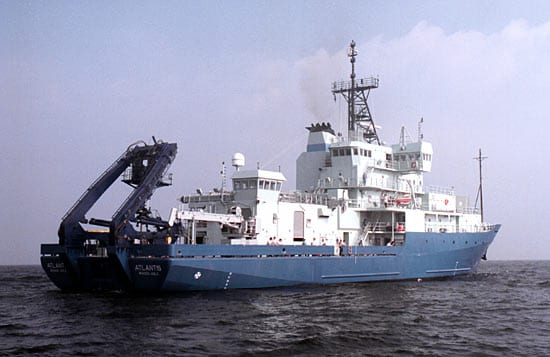
Atlantis photo 1USAphoto: Woods Hole Oceanographic Institution

Oceanography

Loading map…

Oct 2025 – Oct 2026 · 23 port calls · 109 at-sea periods

37

Research bunks

83.5 m

Length

60

Endurance

23

Crew

Projects

20+ past · 4 upcoming

Completed

Ancillary-OOI-RCA-2025 (Multi-Scale Geodesy-5of8)

Bill Chadwick · OSU

Axial Seamount is the most active submarine volcano in the NE Pacific, having erupted in 1998, 2011, and 2015. Because of this, it is an ideal natural laboratory for the long-term study of active processes at a submarine volcano, with periodic perturbations to hydrothermal systems and chemosynthetic biological communities. Long-term monitoring at Axial has built a remarkable time-series of bottom pressure measurements and repeated bathymetric mapping with Autonomous Underwater Vehicles (AUVs) that have documented a cycle of inflation and deflation of ±2-4 meters that has been used to forecast eruptions with increasing accuracy. Since the 2015, Axial has reinflated to >90% of its pre-eruption threshold, but over this same time period the rate of inflation has slowed by an order of magnitude. Consequently, the next eruption is still likely several years away. This project aims to continue this monitoring effort for another 5 years, while improving the techniques, survey designs, and data analysis on several fronts in order to provide improved constraints for modeling the surface deformation to better understand the magma supply and storage system at the volcano. For this project, we request support for field work with ROV Jason and AUV Sentry at Axial Seamount in 2024, 2026, and 2028. Specifically, we propose to: (1) continue the deformation surveys every other year, including both pressure measurements and AUV bathymetric re-surveys over the next 5 years, (2) modify the ROV-based pressure surveys to become more time-efficient by changing reference sites so that we can add more benchmarks in the caldera to better constrain deformation models, (3) add benchmark sites to constrain slip across the caldera faults to increase our understanding of the relationship between deformation and seismicity, and (4) continue OOI Regional Cabled Array (RCA) seafloor-CTD turn-arounds so that salinity sensors will be in place in the caldera during the next eruption to test a hypothesis about co-eruption brine release. These multi-scale monitoring efforts at Axial Seamount will be leveraged by NSF’s infrastructure investment in the OOI-RCA, which provides real-time monitoring data that greatly enhances these efforts. The results from this study will also help to increase our understanding of the shallow magma supply and storage systems at active basaltic volcanoes, the processes that lead to and trigger eruptions, and the pathways that magma takes to the surface during eruptions. This work at Axial Seamount is aimed at helping us better understand eruption processes at volcanoes on land that are more hazardous to people and property.

Aug 4 – Aug 29, 2025 · 25 d

Juan de Fuca Plate

Sails with 2 other projects

Completed

MagmaVent2023

Guangyu Xu · UW

Magmatic activity along the mid-ocean ridge system accounts for a large portion of the earth’s volcanic output. Associated hydrothermal processes in this system provide a key linkage between the lithosphere and the hydrosphere, transferring significant heat and chemicals to the ocean. At submarine volcanoes in particular, the influx and output of magma appears to vary over time, producing years-to-decades-long cycles of inflation and deflation, which in turn cause pronounced variations in the overlying oceanic crust and the hydrothermal circulation hosted within. Understanding the dynamics of these variations is critical to advancing our knowledge of magma-hydrothermal interaction. Seafloor hydrothermal systems are primarily regulated by their subsurface heat supplies and hydrologic properties such as permeability that regulate crustal fluid flow. The considerable difficulties in establishing concurrent, long-term monitoring of these sub-seafloor properties and surface venting have greatly limited our understanding of hydrothermal variability in relation to submarine magmatic processes. This project will fill this knowledge gap by 1) conducting long-term, high-resolution, time-series measurements of hydrothermal effluent temperature at multiple vent sites across the summit caldera of Axial Seamount, and 2) analyzing the tidal modulation of venting temperature using a one-dimensional, multi-layer poroelastic model to constrain permeability and its temporal variations within the upflow zones beneath the instrumented vent sites. The results from our proposed study, when cross-examined with the observations from the unparalleled geodetic and seismic monitoring established at Axial as part of the OOI-RCA observatory along with existing complementary geophysical observations, will provide a broad context of unprecedented details for us to address the compelling research question: how does hydrothermal discharge vary, in both space and time, in relation to magma movements and associated changes in upflow-zone permeability at Axial?

Aug 4 – Aug 29, 2025 · 25 d

Juan de Fuca Plate

Sails with 2 other projects

Completed

OOI RCA 2025 AT

Deborah Kelley · UW

This cruise is in support of the National Science Foundations Ocean Observatories Initiative Regional Cabled Array (RCA) annual operations and maintenance cruise and will require an ROV (either ROPOS or Jason). It is anticipated that over 100 instruments will be turned (recovered with refurbished instruments reinstalled). Operations will visit all of the RCA sites located west of Newport along the Cascadia Margin (80 m - 2900 m water depth) and ~300 miles off shore at Axial Seamount (~ 2600 m to 1500 m water depth). During the cruise, 6 science pods on the three 2-legged Shallow Profiler moorings at the Slope Base, Axial Base, and the Oregon Offshore sites will be turned. The field program will also turn multiple secondary junction boxes (maximum weight ~ 3200 lbs). The cruise will be hosted on the interactiveoceans website with live streaming of deck and ROV operations and will include the undergraduate students that participate in the UW at-sea experiential learning program VISIONS (VISIONS'25). Similar to past cruises, additional NSF and ONR- funded days will be added onto the RCA field program through PI ship requests. Two legs will be required with 2-3 days in port between legs (Newport, OR).

Aug 4 – Aug 29, 2025 · 25 d

Juan de Fuca Plate

Sails with 2 other projects

Completed

ALVIN Engineering Dive

Rick Chandler · WHOI

ALVIN engineering dive on Sheryl Murdoch cruise

Sep 5 – Sep 22, 2025 · 17 d

NE Pacific, Canadian waters

Sails with 1 other project

Completed

ENCUP

Sheryl Murdock · ASU

The Endeavour N-cycling under pressure project will measure rates of microbially-mediated nitrogen cycling processes in a deep-sea hydrothermal vent ecosystem. Rate measurements will occur using diffusely venting hydrothermal fluids, prioritizing fluids colonized by Ridgeia tubeworms. Along the Eastern Pacific, these tubeworm assemblages are known to slow the dispersal of hydrothermal fluids and provide habitat for other species of invertebrates and microbes. Tubeworm bushes expand the spatial extent of reduction-oxidation gradients and favor nitrogen recycling processes that have not been measured in these vent environments. We will collect venting fluids using two methods - one that allows fluid depressurization during ascent and one that maintains deep-sea pressure. Rate measurements will be performed shipboard under atmospheric and in-situ pressures using stable isotope (15N) labeled tracers. We aim to adjust previous estimates of losses of bioavailable nitrogen in these systems by running experiments at deep-sea pressures and including previously overlooked nitrogen recycling pathways.

Sep 5 – Sep 22, 2025 · 17 d

NE Pacific, Canadian waters

Sails with 1 other project

Completed

Transit Cruise

Kerry Strom · UNOLS

Sep 25 – Sep 30, 2025 · 5 d

Completed

CCE-LTER IV - process 2

Katherine Barbeau · SIO

The California Current Ecosystem (CCE) Long-Term Ecological Research (LTER) site is a coastal upwelling biome and the site of a 73-year (ongoing) spatially-resolved ocean timeseries (CalCOFI) that has demonstrated physical forcing on multiple spatiotemporal scales with concomitant impacts on ocean biota. The CCE is part of the larger LTER Network, founded in 1980 by the National Science Foundation. CCE-LTER studies are making excellent progress towards diagnosing mechanisms of ecosystem change in a major upwelling ecosystem and developing a quantitative framework for forecasting future changes. Our field site is in the CA Current upwelling regime, centered around Point Conception, within the CalCOFI time series station plan. The CCE LTER field program includes several different elements: experimental process cruises, time series cruises (ship time augmented on existing CalCOFI cruises) and mooring servicing cruises to maintain the deep water CCE1 and CCE2 moorings. The science carried out on these field expeditions is highly interdisciplinary, involving elements of biological, chemical, and physical oceanography.

Oct 18 – Nov 17, 2025 · 30 d

Southern California, within CalCOFI grid

Completed

LIBS on Jason (year 2 of 2)

Alan Chave · WHOI

This project supports the test deployment of a completed laser induced breakdown spectroscopy (LIBS) system at seafloor hydrothermal vents using the remotely operated vehicle Jason as the support platform. Jason serves to align and orient the LIBS system using a three degree-of-freedom mechanical platform, and also provides high data rate bidirectional communication with the spectrometer. The testing will be based on two scientific use cases that are highly relevant to hydrothermal vents in a generic (i.e., not site specific) sense: the study of near-critical behavior of vent fluids and understanding chemical variability over a tidal cycle. Upon validation, the LIBS system will be made available to the hydrothermal vent science community.

Jan 8 – Jan 31, 2026 · 23 d

Vent fields at Juan de Fuca Ridge

Sails with 3 other projects

Completed

EPR 9°N Eruption 2025 RAPID

Jason Brent Sylvan · TAMU

In May 2025, an eruption started at this site, presenting a unique chance to understand factors governing biological production in the ocean and to observe vent ecosystems at the start of recovery, all driven by deep Earth processes. This event represents a rare opportunity to address key ecological questions that cannot be answered when the system is in its typical unperturbed state. Scientists have been monitoring this site for decades and these sustained data sets provide essential context for interpreting the influence of an eruptive perturbation. We hypothesize an eruption-related pulse of microbial production that we will test through measurement of primary productivity, exoenzyme activity rates, and biologically active chemicals (e.g., carbon dioxide (CO2 ) and methane (CH4)) in the vent fluids. We will also investigate recovery of vent communities via analysis of larve and photo imagery. We hypothesize that the larvae in the plankton will change in species composition from pre-eruption, as local source populations are eliminated and larval supply is replaced by dispersers from remote sources. We suspect that these pioneers will drive subsequent succession, possibly in a direction that differs from prior eruptions, and will collect them with benthic landers and via sampling of vent structures.

Jan 8 – Jan 31, 2026 · 23 d

Vent fields at Juan de Fuca Ridge

Sails with 3 other projects

Completed

Silverfish Deployment

Alyssa Gurkas · EE

Endurance Energy is developing offshore geothermal energy to convert Earth's most abundant and clean energy resource into grid-scale electricity. Endurance Energy’s long-term vision for offshore geothermal energy supports solving the United States’ power shortage, grid-scale decarbonization, and providing affordable power to remote communities. We are a venture funding-backed startup based in Seattle, a short walk from the University of Washington. Hydrothermal vents serve as an ideal testing ground for our power-generating systems. We are applying to piggyback on Dr. Alan Chave's Laser Induced Breakdown Spectroscopy System from ROV Jason expedition and deploy our prototype to the hydrothermal vents at EPR in August 2026. The deployment will involve site preparation, placement of the prototype, and instrument recovery. The system should be on the hydrothermal vent for at least two hours, but ideally should be placed longer.

Jan 8 – Jan 31, 2026 · 23 d

Vent fields at Juan de Fuca Ridge

Sails with 3 other projects

Completed

RAPID: EPR Eruption 2025

Jill McDermott · Lehigh

In April 2025, scientists aboard HOV Alvin made the first direct visual observation of molten lava erupting on the seafloor at a mid-ocean ridge, at 9°50′N on the East Pacific Rise. This extraordinary event, predicted by long-term monitoring of hydrothermal activity, provides a time-sensitive opportunity to study how submarine eruptions begin and how they alter the chemistry and circulation of hydrothermal systems. The eruption generated a large hydrothermal plume, offering a rare chance to track the evolution of a “megaplume” and its effects on biogeochemistry. During this cruise, our team will work alongside the funded project led by Chave (PI) and Humphris (co-PI), “Collaborative Research: Deployment of Laser Induced Breakdown Spectroscopy System from ROV Jason.” We request 1.5 additional days of ship and ROV Jason time to recover and redeploy high-temperature loggers, collect hydrothermal fluids and lava samples, and survey plume distribution. These observations will constrain changes in crustal permeability and vent fluid chemistry following the April 2025 eruption and test models for plume formation and dispersal. Together with seafloor mapping and instrument recoveries, this work will capture time-sensitive changes to the hydrothermal system and contribute new insight into the role of submarine eruptions in shaping seafloor and ocean processes.

Jan 8 – Jan 31, 2026 · 23 d

Vent fields at Juan de Fuca Ridge

Sails with 3 other projects

Completed

Transit Cruise

Eric Benway · WHOI

Feb 4 – Feb 9, 2026 · 6 d

Completed

Pioneer-Adjacent CPIES rescue

Magdalena Andres · WHOI

Through this project we have (1) deployed two current- and pressure-sensor-equipped inverted echo sounders (CPIESs), each equipped with four Popup Data Shuttles (PDSs), on the 1000-m isobath just northeast of Cape Hatteras, North Carolina and (2) established a data pathway to share the batches of CPIES observations broadly with the research community and other stakeholders as soon as they are available after download via satellite. The data records provided by the CPIESs are supporting stand-alone science to study physical oceanographic processes on the southern Mid Atlantic Bight (MAB) continental slope over a range of temporal scales and are also complementing the shelf-focused observations from the neighboring Ocean Observatories Initiative (OOI) Coastal Pioneer Array. The CPIESs, which are bottom landers, provide invaluable in situ measurements on the slope—a location that is difficult to observe with water column moorings, due to the intermittent presence of the strong Gulf Stream jet and potential conflict with fishing gear (e.g., from pelagic longlines or nets). In turn, observations from the Pioneer Array are providing information about the regional water masses that give spatial context for the CPIESs’ time series measurements.

Apr 21 – Apr 28, 2026 · 7 d

Cape Hatteras, NC

Completed

ALVIN Sea Trials

Rick Chandler · WHOI

Conduct post-overhaul ALVIN sea trials between Woods Hole and Norfolk VA with an intermediate stop in Bermuda

Jun 8 – Jun 28, 2026 · 20 d

SE of Bermuda

Completed

Q_TN Wrecks

Dwight Coleman · WHOI

We are planning a reconnaissance survey of the Quest and Terra Nova Shipwreck Sites to collect ultra-high resolution imaging data and produce photogrammetric models. Quest is located off the coast of Labrador, in Canadian waters and Terra Nova is located off the coast of Greenland in Danish waters. We will use the R/V Atlantis, HOV Alvin, and ROV Falcon to complete an archaeological inspection of the sites, assess their state of preservation, study the oceanographic and environmental context of the sites, including the benthic ecology of the wrecks as artificial reefs. Project sponsors/partners are with the Royal Canadian Geographic Society. Their collaborator, who will serve as Chief Scientist, is David Mearns, a chartered marine scientist and oceanographer who specializes in deep-water search and recovery operations, including the discovery and analysis of historic shipwrecks.

Jul 2 – Jul 22, 2026 · 20 d

Off the coast of southern Labrador and off the southwest coast of Greenland

Completed

Hydrothermal vent shrimp vision

Tamara Frank · Nova

Decapod shrimp in the family Alvinocarididae are some of the most abundant mobile fauna at hydrothermal vents, occurring in massive swarms at Pacific, Indian and Atlantic vent sites. Originally described as eyeless, vent shrimp are now known to undergo dramatic transformations in eye morphology with some species having massive fused eyes on their backs (dorsal eyes), which may be correlated to their feeding preferences. Previous studies have demonstrated that some vent shrimp species with dorsal eyes rely primarily on carbon provided by epibiotic bacteria, while others with fused anterior eyes are predators/scavengers, and suggested that there may be a correlation between eye structure and feeding modality. Due to the different local habitats where these shrimp are found in (water column for post-larval, on black smoker sides for the species that graze on bacterial mats, out in the periphery for species that rely on predation) the eye morphology and visual pigments may also be adapted for finding the correct habitat. However, all the structural studies that have been undertaken on the benthic adults to date suggest that they are blind or the eyes are degenerating. These results are contradicted by studies demonstrating that the pelagic post-larvae/juveniles with stalked eyes appear to be visually competent. It is unlikely that the metamorphosis from a normal stalked eyes (post-larvae) to the huge dorsal eyes (adults) results in a degenerated eye. As all earlier studies utilized adult shrimp that had been collected under bright submersible lights, it is likely that degeneration” resulted from significant photoreceptor destruction caused by too much light. An additional challenge of vent shrimp visual ecology is that the eyes were considered degenerate due to lack of enough ambient light to make the metabolic costs of vision worthwhile. However, there may be several sources of sufficient ambient light produced by both abiotic triboluminescence/chemiluminescence as well as biological bioluminescence. Although several studies suggest bioluminescence does not exist at these vent sites, incorrect methodology may have resulted in this conclusion. Using molecular, physiological, and structural methods the PIs have developed over decades to study vision and bioluminescence in deep-sea crustaceans, the visual capabilities of vent shrimp (postlarvae, juvenile and adults) will be tested against hypotheses related to both feeding modality and habitat selection. These measurements will be coupled with a systematic survey of pelagic and benthic luminescence at the vents to determine if these are viable visual stimul

Jul 27 – Aug 21, 2026 · 25 d

Mid Atlantic Ridge

Sails with 1 other project

Completed

ALVIN Engineering Dive

Rick Chandler · WHOI

Aug 29 – Sep 19, 2026 · 20 d

Norther U.S. Atlantic Margin

Sails with 1 other project

Completed

USAMSeeps-3

Davide Oppo · TAMU

Methane seeps affect the geology, ecology, and chemistry of the near-seafloor environment. We will investigate newly-discovered methane seeps along the slope of the northern US Atlantic Margin. We will describe and study the characteristics, biogeochemistry, and evolution over the geological time of seeps along two representative transects extending from the shelf edge to the continental rise.

Aug 29 – Sep 19, 2026 · 20 d

Norther U.S. Atlantic Margin

Sails with 1 other project

Completed

Transit Cruise

Kerry Strom · UNOLS

Sep 23 – Sep 30, 2026 · 7 d

Underway

Galapagos wire walker

Harvey Seim · UNC

We seek a few days of shiptime to recover and redeploy a Wirewalker mooring within the Galapagos archipelago and do some simple water sampling at both locations. The mooring is configured to be deployed in roughly 400 m of water and is presently ~20 km north of Kicker Rock off the NW coast of San Cristobal Island. We wish to recover the mooring and redeploy it in Elizabeth Bay on the west side of Isabela Island. These two deployments are funded components of our NSF project "Collaborative Research: BoCP-Implementation: The influence of different nutrient delivery modes on functional biodiversity of marine plankton in a changing ocean". The Wirewalker was deployed last summer from the RV Langseth and we had intended to use an Ecuadorian vessel for the recovery and redeployment but that has not been possible to arrange. We estimate 3 days of shiptime will be needed, half of which is transit time between the two locations.

Oct 4 – Nov 9, 2026 · 36 d

West Galapagos Ridge

Sails with 1 other project

Underway

Galapagos MT

Steven Constable · SIO

Understanding how melt aggregates in the mantle during melting remains a critical open question in mantle geodynamics and volcano science. Although melt transport has been typically modeled as diffuse porous media flow, a variety of geological, geochemical, experimental, and theoretical results suggest the possibility of melt localization at lengthscales of 10s of m - km due to two-phase flow instabilities (e.g., reactive transport, shear banding) and long-distance (100s of km) lateral melt transport. However, it has been challenging to observationally validate theoretical models of two-phase melt transport and assess the importance of melt channelization in the mantle across different tectonic settings. One geodynamic setting that provides an ideal natural laboratory to understand this sub-lithospheric melt transport and extraction is the interaction of the off-axis mantle plumes with nearby mid-ocean ridges (< 1000 km distance), wherein the mantle plume provides a distinct geochemical tracer (compared to MORB) for tracking melt transport processes. The key characteristic of this interaction is the presence of volcanic lineaments such as the Wolf-Darwin Ridge in Galápagos, a ~ 200 km long volcanic feature. In our previous work we find that a variety of geophysical and geochemical observations for the Galápagos lineaments are naturally explained in a model where the Wolf-Darwin lineament overlies a volatile- and melt-rich channel connecting the Galápagos plume to the Galápagos spreading ridge. Such lineaments are found in other plume-ridge interaction settings worldwide (e.g. Reunion, Easter, and Discovery). We propose to use a combination of new geophysical (MT data, geodynamics models for 3D plume flow) and novel geochemical observations of the Galápagos lineaments and the Galápagos spreading ridge. Specifically, we propose to use an array of ~ 60 state-of-the-art broadband marine MT instruments to measure the sub-lithospheric electrical conductivity in sections along and across the lineaments and the plume-affected ridge segments. Synthetic MT modeling demonstrates that the conductivity signals associated with sub lithospheric melt channels that we hypothesize are very likely to be detectable. We will couple the results from the MT survey with first principles geodynamical models for Galápagos plume flow towards the ridge and the associated two-phase flow instabilities in order to test the thermodynamic consistency of our findings and discern among the different possible melt channelization mechanisms. Finally, while the MT instruments are recording data, we propose to collect dredge samples along both the northern Galápagos volcanic lineaments and the lineamentspreading ridge intersections to estimate the melt volatile content and geochemically constrain the contribution of the plume component using a combination of rare earth modeling and novel isotope measurements. This work will lead to significant, if not transformative, advances in our understanding of plume-ridge interaction and mantle melt transport processes in general

Oct 4 – Nov 9, 2026 · 36 d

West Galapagos Ridge

Sails with 1 other project

Scheduled

Costa Rica Wave Glider

Mark Zumberge · SIO

The R/V Atlantis will be making a transit cruise in early November from Golfito to Manzanillo. We request that two technicians from Scripps join the transit cruise to launch a Wave Glider on the transit route. We expect it will lengthen the duration of the cruise by an hour and a half.

Nov 13 – Dec 2, 2026 · 19 d

Eastern Tropical North Pacific

Sails with 1 other project

Scheduled

SAR11 in OMZS

Frank James Stewart · Montana

Marine microbial communities often harbor many closely related, yet distinct lineages or clades. What drives this microdiversity and, importantly, what is the level of functional redundancy among the clades and the value of this diversity for ecosystem functioning and resilience remain poorly understood questions that are highly relevant for better understanding and modeling the diversity and ecological contributions of marine microbes. Oxygen minimum zones (OMZs) are ideal sites to study functional diversification and redundancy as they represent highly productive, high biomass regions of the ocean. These zones are characterized by phylogenetically and functionally diverse microbial assemblages with key roles in global nutrient cycles, notably the anaerobic conversion of bioavailable nitrogen to nitrogen-containing gas. Further, OMZs are predicted to expand as an effect of climate change, making the ocean less hospitable for fish and other marine organisms and likely exacerbating climate change by releasing potent greenhouse gases, including nitrous oxide (N2O) produced from microbial denitrification. Despite the importance of OMZs for the ocean ecosystem and the intense research focus on OMZs during the past two decades, good model organisms that represent key players in OMZs and can be studied to advance current understanding of organic matter and greenhouse gas turnover in OMZs, as well as processes of microbial diversification, are lacking. Our team has recently made an important discovery describing unanticipated patterns of microbial diversity and functions in OMZs (Tsementzi et al. 2016, Nature). Using a combination of single-cell genomics, biochemical rate measurements, and enzyme assays, we showed that OMZ SAR11 bacteria, the most abundant group of heterotrophic bacteria in the oceans, span several diverse clades distinct from those of oxygen-rich waters. Notably, OMZ SAR11 have acquired the ability to respire nitrate in place of oxygen, resulting in the production of nitrite, a critical intermediate for downstream processes of nitrous oxide or dinitrogen gas production via either denitrification or anaerobic ammonia oxidation (anammox). These results implicate SAR11 as a major but previously unrecognized contributor to pathways of ocean nitrogen loss. However, the environmental conditions driving the diversification and niche specialization of low oxygen-adapted SAR11 remain essentially uncharacterized, as does the quantitative understanding of the contribution of SAR11 to OMZ biogeochemical cycles, notably dissolved organic matter (DOM) degradation and nutrient cycling. With a good model organism in hand (OMZ SAR11), several metagenomes, single amplified genome sequences and archived samples from various OMZs available, and an experienced research team, this proposal is poised to provide new insights into marine microbial diversity and function. We propose two specific objectives: 1. Elucidate the underlying mechanisms that maintain clade diversity in OMZ SAR11. We hypothesize that each clade has unique gene content tuned to specific conditions of oxygen, nutrient, and DOM availability. We will employ single cell genomics and long-read metagenomics to characterize hundreds of SAR11 representatives from the world’s largest OMZ to test this hypothesis. 2. Quantify the relative contribution of distinct OMZ SAR11 subclades to community composition and metabolism across OMZ chemical gradients. We hypothesize that adaptation by distinct SAR11 subclades to the OMZ involves differential gene content as well as differential expression of shared gene content (including the two copies of nitrate reductases) depending on oxygen, nitrate, and DOC availability. To test this, we will use metatranscriptomes and chemical and rate measurements sampled at high spatial resolution over depth in the OMZ and in incubations amended with varying oxygen and nitrate levels. Intellectual merit: Despite intensive research over the last few decades, quantitative understanding of the biogeochemistry of OMZs remains incomplete, in part due to a lack of appropriate model organisms for study. We will optimize current and develop new genomic approaches to efficiently study key uncultivated organisms in OMZs and provide new insights into their activity and their role in the cycling of nitrogen and carbon. Therefore, this project will fulfill a critical gap in our understanding of biological diversity in the oceans and provide lessons and techniques that will be useful for studying other marine microbial processes.

Nov 13 – Dec 2, 2026 · 19 d

Eastern Tropical North Pacific

Sails with 1 other project


Are you the operator of this vessel?