NGA-LTER Spr2024
Completed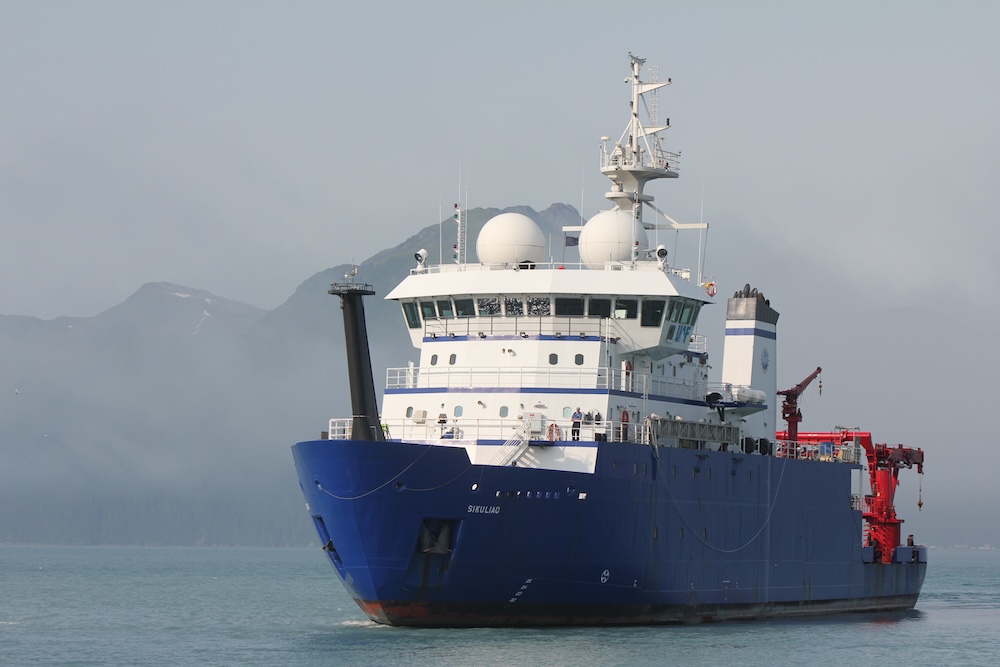
Operating area: Northern Coastal Gulf of Alaska
Route: Seward (Alaska) - United States → Seward (Alaska) - United States
Project aboard
The NGA is a highly resilient ecosystem, due to the intense levels of environmental variability experienced by the biological community. We define resilience as recovery of key emergent properties (a diatom-dominated spring bloom; hot spots of high summer production; high biomass of large, lipid-rich copepods; high rates of particle export to depth; efficient transfer of production to upper trophic levels) following disturbance. These properties arise from the interplay of physical and chemical properties together with the genetic repertoire of the ecosystem’s component species, and in turn are key to the maintenance of high productivity at upper trophic levels, including commercially harvested groundfish (e.g. black cod, pollock, rockfish), seabirds, and marine mammals. Our approach to evaluating resilience includes: Examining the recovery (or lack thereof) of emergent properties following disturbance (e.g., marine heatwaves); Distinguishing food web pathways that are more versus less sensitive to disturbance; Tying observations of lower trophic level responses to their consequences for higher trophic levels under different (in time and space) conditions; Examining the occurrence and consequences of strategies, such as nutritional plasticity and species redundancy, thought to promote resilience. Assessing the availability of various iron and macronutrient sources After the Regular LTER work is completed we will exchange much of the scientific crew and return to the shelf break to begin a detailed study of deep-water zooplankton communities at several stations station that end end at the Giacomini and Quinn seamounts. We will be using plankton nets and the ISIIS-DPI to examine these communities and look for any perturbations in community structure associated with these features.
People aboard
- Russ Hopcroft · Principal investigator
Party size: 24
Estimated vacant berths: 0
Equipment
Aboard the vessel
- Ship Fitted Winches & Wires
- Overboarding Cable - Copper Conductor(s)
- Overboarding Cable - Fiber Optic
- Crane
- Stern A-Frame
- Navigation - Heading/Position
- Underway Seawater System
- pCO2
- Meteorological Data
- Echosounder, 12kHz
- ADCP/UHDAS – range < 80m (eg. 300kHz)
- ADCP/UHDAS – range 250-350m (e.g. 150kHz)
- ADCP/UHDAS – range 1000m-1200m (e.g. 38kHz)
- ADCP/UHDAS – range 500-750m (e.g. 75kHz)
- Multibeam - Shallow-water (EM710/712/2040/Seabat 7100)
- Multibeam - Mid-Water (EM302/304)
- Biological multi-frequency echosounder - EK80
Pooled / portable
- CTD
- MOC-1
- Winch Pool Portable Winch
Schedule data from UNOLS Marine Facilities Planning · operator cruise code SKQ202407S · MFP reference 23/2856 · synced Sep 24, 2026