SIO 277
Completed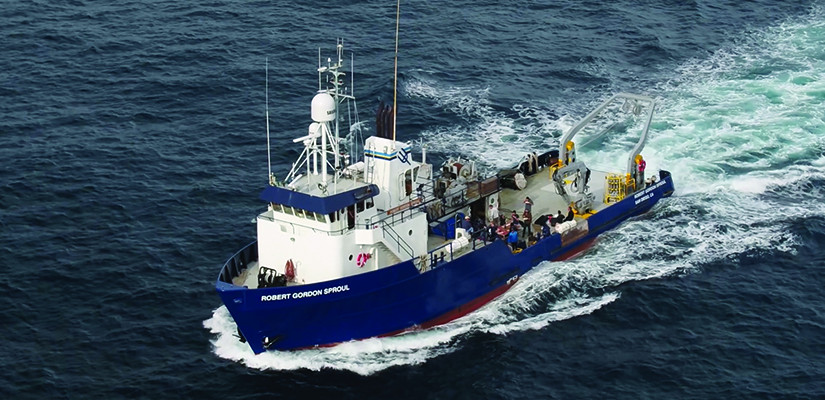
Operating area: San Diego Trough and Del Mar Seep, Southern California
Route: San Diego (California) - United States → San Diego (California) - United States
Scripps Institution of Oceanography
Project aboard
This cruise offers the students enrolled in Deep-Sea Biology (SIO 277) a rare hands-on opportunity to work with deep-sea organisms, and has become an essential part of the course. Due to Covid Restrictions and expected large class size we will repeat identical activities on two different days, ideally on 2 separate weekends. The goals of the cruise are to (1) demonstrate the different types of instrumentation used to study the biology of deep-sea organisms including CTD, multicore, Isaacs kid midwater trawl and otter trawl (2) generate hydrographic data illustrating features of the deep CA margin (e.g., thermocline, oxygen minimum zone, carbon maximum zone, nepheloid or benthic boundary layers), (3) visualize and recover deep-sea animals characteristic of midwater, continental margin and possibly methane seep environments, and (4) provide at-sea experience to students along with detailed explanations of ship operations and facilities. Work will be conducted in the San Diego Trough (1200 m), offshore of Point Loma and on the continental margin at and near the Del Mar Methane Seep (1038 m).
People aboard
- Lisa Levin · Chief scientist
- Lisa Levin · Principal investigator
Party size: 10
Estimated vacant berths: 2
Equipment
Aboard the vessel
- ADCP/UHDAS – range 1000m-1200m (e.g. 38kHz)
- Multibeam - Deep Water (EM122, EM124)
- Multibeam - Shallow-water (EM710/712/2040/Seabat 7100)
- Multibeam - Mid-Water (EM302/304)
- Biological multi-frequency echosounder - EK60
- Biological multi-frequency echosounder - EK80
Pooled / portable
- CTD
- Sediment Core
- Other Seafloor Sampling Equipment
- Isaacs Kidd Midwater Trawl (IKMT)
- Towed or Vertical Net System
Schedule data from UNOLS Marine Facilities Planning · operator cruise code SP2202 · MFP reference 21/1196 · synced Sep 24, 2026